
The young man in front of me was having problems. The woman at the check in counter for the Vietnam Airlines flight from Vientiane to Phnom Penh looked past him at me and said something. He turned around, saw me with only a carry-on bag and asked if that was all the baggage I was travelling with.
I knew what was coming next, having been asked this question dozens of times on flights from Bangkok to India. Allowing other passengers to use your unused baggage allowance is fraught with dangerous consequences and I was about to refuse, when his explanation came gushing out. He was going home to Cambodia after graduating from a university in China. In the five years there, he had collected a lot of books and now didn’t have enough money to pay for his excess baggage. In pre-Kindle days, books invariably constituted a large part of my luggage. I understood and readily agreed.
We checked in together because of the baggage and ended up sitting next to each other. On the flight to Phnom Penh, we chatted about student life in China and my experiences as an EFL teacher in Vientiane. He asked me why Lao students received so many more scholarships to study abroad than Cambodians. I didn’t know that but made a mental note to find out. It was my first visit to Cambodia and I started to ask him about hotels, places to eat, sites to visit and things to do but he wasn’t of much help having lived abroad for so many years.
He asked where I was staying in Phnom Penh and I said the Indochine Hotel. He didn’t know of it, but knew the location and offered to drop me there.
We landed at a near empty Pochentong International Airport and cleared immigration quickly. While we were waiting for all his/our baggage, he noticed that I didn’t have my cabin bag. I had walked off the aircraft leaving it in the overhead locker.
True, this wasn’t the first time something like this had happened. In the past – and it was to happen again and again in the future – I had left behind books, bags, wallets and mobiles in planes, trains, buses and taxis.
We hurried to a customs officer and the young man said something to him in Khmer. The official shouted out to somebody who hurriedly took me back to immigration and more words were exchanged. Then an official kept my passport and handed me over to somebody from the Vietnam Airlines ground staff. We raced back to the aircraft and pushed past the passengers who were boarding for the onward flight to Ho Chi Minh City. I went straight to the overhead locker and retrieved my bag, which by now was squeezed into a corner. The passenger sitting where I had sat asked me if the Lonely Planet guide book was mine. I thanked him and apologised to everybody around.
I collected my passport from immigration and the customs official just waved me through.
The young man smiled when he saw my bag, then introduced me to his parents and younger brother. His father said something and he translated. I was being thanked for helping his son with the baggage allowance. His father then insisted that I join them for lunch before going to my hotel. I politely refused saying that the family would want to spend time with their son whom they had not seen for many years but the young man smiled and insisted.
We drove to the restaurant in a chauffeured car with a flashing blue light on top. I didn’t pry but from the little I gathered, his father was a high level bureaucrat.
After lunch, they dropped me at the hotel and I insisted on reciprocating by inviting the two boys to dinner on any of the next couple of days that I was going to be in Phnom Penh. They accepted, said they would come the next evening but never ever got in touch again.
Phnom Penh struck me as being a bit of a wild west town. There was a palpable feeling of violence but this might have been because of its recent past. Or, maybe because of stories I had heard about its people; friendly and gentle, yet sometimes capable of great anger at the merest slight.
The feeling of sleaze was more apparent. I lost count of the number of times I was propositioned by male and female, from young children to toothless crones. I suppose that I fit a certain profile; lone male traveller of a certain dotage. Later, it dawned on me that the reason why the young man who I had helped with the excess baggage didn’t turn up for dinner was probably because he thought I was a sex tourist.
Despite the oppressive heat of those July days, I walked a lot on that first visit to Phnom Penh. I explored the lanes and bye-lanes, observing street life. Staring at old buildings, I wondered what stories lay behind those dilapidated walls. The people were lovely and friendly, and ever ready to help when asked for directions. I remember one shop keeper sending an assistant to show me a place, several streets away, where I could buy camera batteries. Yet, as a history buff, my thoughts kept going back to the barbaric years of the Khmer Rouge. At Tuol Sleng and the Killing Fields, I wondered how a gentle people could be transformed into such remorseless killing machines.
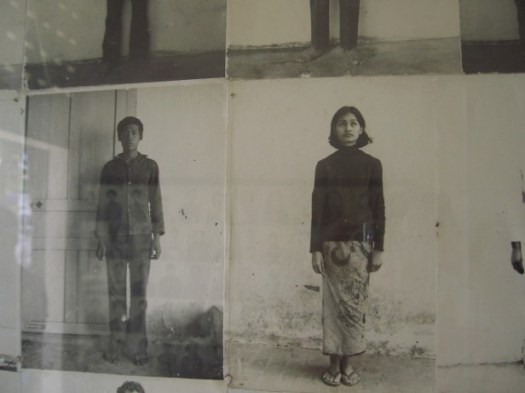
Wiping my sweaty glasses, I remembered grimly that during the Khmer Rouge years, spectacles were a sign of being literate, and a passport to the labour camps and subsequent extermination.

One day, I hired a cyclo to show me a few places not mentioned in Lonely Planet. The driver spoke a fair amount of English and I felt safe asking him questions about the past but he was more interested in talking about the present. I treated him to lunch at a restaurant he would never have been able to afford unless he won a national lottery. After the initial self-consciousness, he ranted and raged against the rampant corruption and thuggery of the ruling classes. On the road when an SUV with tinted rolled up windows muscled through the traffic, I pointed out the lack of a number plate. He turned and whispered, ‘corruption’.
Restaurant clientele were mainly western men, tankards of beer in hand, often accompanied by an underfed local girl in a low-cut top and hot pants. While the foreign men talked to each other, the girls would sit mutely beside them nursing soft drinks or chatting to the other ‘working girls’ at the table. There were numerous stories that when the UN and other international aid agencies moved in after the Pol Pot years, prostitution and AIDS soared
The poverty was apparent everywhere and as always there was the nagging feeling that quite a few people were thriving from it: the regime with some of its ex-Pol Potters, their families and friends and the foreign consultants gorging on fat consultancies. The words of Tarzie Vittachi, the Sri Lankan journalist, came to mind: ‘A foreign expert is somebody who comes to find out and leaves before he is found out’.
COMMENTS
Juhi
Very well written. Nice you incorporated history into it!! You do have an amazing writing talent
© Percy Aaron
 Wow Laos