The Mist in the Mountains

mist 01

(A version of this article was first published in Live Encounters, August 2021: https://liveencounters.net/2021-le-mag/08-august-2021/percy-aaron-misadventures-in-the-mountains/)

From Hatsa, a small trading post on the banks of the muddy Nam Ou River in remote northern Laos, we sailed upstream through some stunning and largely unspoilt scenery. At times the colour of the water changed to a deep ochre. The current was strong and the boatman guided us skillfully past the occasional rapids splashing water onto everyone and filling up the boat. His assistant sat on the prow using an oar to push the craft away whenever it got close to any of the rocks. On placid stretches he kept himself busy baling out the water.

At regular intervals the boat stopped for villagers to get on or off and after about forty-five minutes it was our turn. We waded onto a sandy, deserted bank. All around us the high hills were covered with tall trees and dense vegetation. The only sounds were the rushing waters and the various bird calls, some recognisable, most not.

Travelling upstream on the Nam Ou

Indian file, we started climbing through dense undergrowth. At times the vegetation was so thick we could see only a few steps ahead. I pulled my cap tight over my head and covered my face with my hands or elbows to protect it from nettles and thorny twigs. Almost immediately the leeches started feasting on us, while the mosquitoes hovered around waiting their turn. We climbed and climbed and I slipped and slipped. Bringing up the rear, it was difficult to keep up with David and Souk, our guide, who had to stop frequently to allow me to catch my breath.

After about an hour of steady climbing I was totally exhausted and just couldn’t go on. I suggested they continue without me. Finding my way back would have been impossible and I was secretly relieved that David disagreed.

Soon I sat down on the path, dizzy from exhaustion and hunger. Sweat poured down my face and back as mosquitoes and large red ants bit me. David opened his backpack and gave me some biscuits and water. After a while I felt better but still didn’t think that I could make it.

David insisted on carrying my backpack and though I felt bad about it, agreed. He then had the brainwave of making me lead the group with the guide bringing up the rear. Souk handed me a thick branch to help me climb. For whatever reason, the journey was now easier with me setting the pace. We still stopped numerous times for rest breaks or to photograph the stunning scenery. 

Darkness at noon
Darkness at noon

Despite the cool mountain air, we were covered with sweat and David, in particular, looked as if he had just stepped out of a sauna. After some time, we reached a clearing and took a longish break. Souk produced some juicy pears from his backpack and told us that this spot was usually the first stop on the trek – we had already stopped dozens of times – and that we were well behind schedule. Our four-hour trek, he felt, was going to be nearer six or seven hours.

We continued to climb with regular breaks for rest or photographs. As we tired, we conserved energy by keeping quiet, each of us lost in our thoughts. Except for the occasional bird call or rustle of leaves, the silence was total. For somebody like me, allergic to noise, the sensation was incredible. This was nirvana.

Taking a break – Souk and David

We ran into some colourfully-dressed ethnic women speaking a dialect that even Souk couldn’t understand. One of them stuck her hand into the bushes and pulled out a bunch of grape-like fruit and offered it to us. They were deliciously tangy.

By early evening, about six hours later – and just one hour behind schedule – we reached the top of the mountain and the Akha village of Ban Jakhampa.

Ban Jakhampa
Ban Jakhampa

Ban (or Village) Jakhampa was a collection of thatched, squalid huts made of bamboo. Only the headman’s place had wooden walls and a roof of corrugated asbestos. Built on the slopes of the mountain, they seemed ready to collapse like a pack of cards. Except for the sounds of cocks crowing and cattle lowing, the village was eerily quiet, almost like a ghost hamlet.

We walked past a number of huts towards the home of our host, the village headman. As we approached, people started popping out of their huts. They stopped what they were doing, or not doing, and stared at us with a mix of suspicion and curiosity. Some way behind, children had appeared and were following us. Much like the Pied Piper of Hamelin, their numbers were growing. Obviously outsiders, especially foreigners, were a rarity in this place.

We arrived at the village chief’s hut, took off our shoes and entered. We were told to keep them on but out of habit had left them outside. Once inside though, I saw how dirty the earthen floor was and after a while went outside and put my shoes back on.

Despite looking small from the outside, the interior was surprisingly large with a big, soot-blackened stove in one corner. None of the huts had windows, and many had low doors. We wondered why Akha building techniques did not include these, since there was no electricity. However, with the cold Phongsaly winters, having no windows probably made sense. Snot-nosed children, dogs and chickens roamed inside freely. Everybody spat anywhere and one child urinated near me. Souk, the guide was given a basin with a little water and after washing his face, threw the rest in the corner near the bed. When it was our turn we did the same.
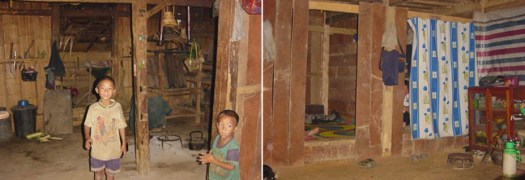
Left: Inside the village chief’s hut. Right: Sleeping quarters in the hut.

Left: Inside the village chief’s hut. Right: Sleeping quarters in the hut.

Though there was no electricity, the hut had a TV and VCR. Later, somebody explained that when rice was being milled, they ran a generator. This was the opportunity to watch a movie or two. The villagers loved Hindi films and I understood why Bollywood movies, with all their oomph and glamour, were so popular among these impoverished people.

We went outside the hut to look around and by now there was quite a large gathering waiting to catch a glimpse of us. The older boys stood close, while the younger ones watched nervously from a distance. I tried to photograph them but they fled as if they had seen a ghost.

After a while we were called into the hut for a bite. Souk had brought some food from Phongsaly. It was a very spare meal of sticky rice, strips of dried beef and some steamed vegetables, washed down with hot green tea. Later, we were offered some opium but politely declined. The village had no toilets and so after the meal we went for a walk to relieve ourselves. We were given a big stick to keep the pigs, and sometimes the dogs, at bay.
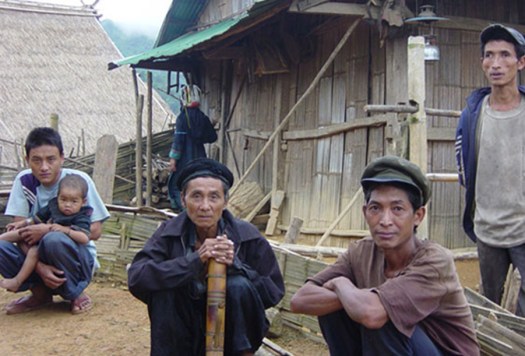
Smoking – the main leisure activity?

The Akha, one of Laos’ many ethnic groups, are animists. They believe that everything, living or otherwise, has spirits and must not be offended by any word or deed. To this end their whole lives are governed by ritual. An abjectly poor people who prefer living in the highlands, they practise swidden or slash-and-burn agriculture. The women in the village wore colourful headdresses, decorated with beads and silver coins; the more elaborate, the better the dowry they had received. Those carrying little babies, moved around with one breast exposed. The unmarried girls generally stayed indoors. Like many mountain people, the womenfolk seemed to do all, or most of the work, while the men just sat around smoking. The younger men too hung around aimlessly, often preening themselves, while the poorly-clad children, most of them with runny noses, seemed so listless.

 Life is a very harsh and dead-end existence for these simple people.

As the sun set, David and I sat outside on a wooden platform, looking out onto the valley and chatted with our guide or those who could speak some Lao. Some asked me about their favourite Bollywood stars, but not being a movie or TV person, I must have disappointed them. Many of the younger men walked around with red – yes, all of them were red – ghetto blasters which got louder as darkness descended.

Later, Souk offered us some more food but I refused pointing out that we had just eaten. The truth was that with no toilets I wanted to eat as little as possible. An anthropologist once told me that when researching in such remote areas, he always carried a big stick to fend off pigs and dogs trying to get at his excrement before he had even finished.

As the sun went down David and I sat on the platform discussing poverty and development. Souk told us that government had plans to move the village to the base of the mountain so that education and healthcare would be more accessible, but the villagers were ambivalent about this. The younger ones thought it would bring jobs and modernity. The older villagers were sceptical of officialdom’s promises. Besides, leaving the land would cut links with the spirits of their ancestors.

Dusk made the village noisier with the many ghetto blasters at full volume. I wondered if this was to scare away the spirits. Many of the young men also carried Chinese-made torches that pierced the darkness like searchlights seeking out enemy aircraft.

Night came and despite the insomniac roosters in the village, I slept surprisingly well. The next day I stayed in bed for as long as possible to delay the need for a clean toilet.

When it was no longer polite to stay in bed I joined David outside on the observation platform. A little later Souk brought me some water for a wash. It was barely enough to brush my teeth. Later he brought us some dry bread rolls and hot coffee. Coffee never tasted better. We munched our rolls and admired the mountains, most of them covered in the early morning by a thick mist. I had never had a breakfast amidst such spectacular scenery.
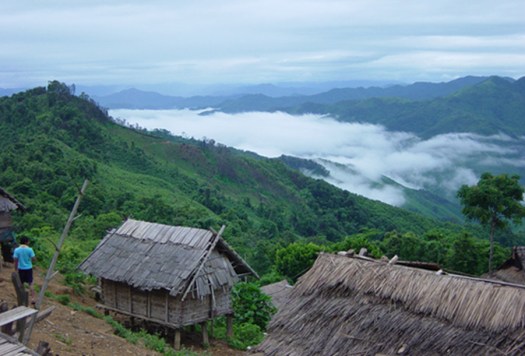
Morning mist with my coffee.

We left Ban Jakhampa at 8.05 am on the return leg of our journey. As we set off, we saw it was raining on some of the distant mountains. We had been lucky with the weather until now, and were sure that our luck would hold. Souk told us that we were returning by a much shorter route and should reach the Nam Ou boat a little after noon.

Once again I led the group, followed by David and then Souk. About fifteen minutes into our journey, it started drizzling. Souk gave me a plastic poncho but it was hot and sticky and kept getting between my legs. Then the drizzle got heavier and soon we were soaked and miserable.

After about an hour, our descent started turning into a nightmare.

Coming down a mountain is more difficult than ascending and even worse in the rain. It should have been obvious that if our return route was shorter, the descent would be steeper.

Some of the paths were about a foot wide and animal hooves had worn them off making sections even more treacherous. Soon I began to dread them. On portions where the tracks were slippery, I put my foot into the grooves made by the animals to avoid sliding off the mountain.

Despite this, I moved faster than David and the guide. On one slippery stretch, when I almost slid off the path, I thought it prudent to slow down and let them keep up with me. It occurred to me that we were so insignificant in that environment, that if anything happened to us, nobody would know anything.

Sometimes the easiest looking paths were the worst. I lost count of the number of times I slipped and fell in the slush. In panic I would grab at any plant or shrub to stop myself from going over. There seemed no end in sight to this nightmare. All around us the heavy silence was punctuated by the chirruping of birds and the patter of rain on the dense foliage.

Finally, I spotted stretches of the river deep below in the distance. I calculated that it was still several hours away. Our shorter journey was turning out to be longer. After some time, I began to hear the roar of the motors from the boats far below and my spirits soared.

Two men were coming in the opposite direction and I flattened myself against the side of the mountain to let them pass on the outside. There was hardly any space between me and the edge but they went by as nimble footed as mountain goats. They said something which I did not understand.

A few minutes later I heard David and Souk shouting and stopped dead in my tracks. I called back but there was no reply. I sensed some urgency and turned back to look for them.
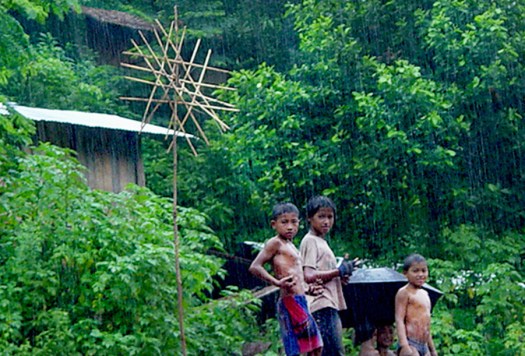
Bamboo sign outside Lao Theung village forbidding entry to outsiders.

The men who had passed me told Souk that the Lao Theung – another ethnic group – village we were approaching was closed to all outsiders for the day. Somebody had died and as per their customs, no outsiders were allowed near the village. The thought of going all the way back filled us with horror and we pleaded with Souk to explain to the villagers that we were just passing through to catch the boat. He was adamant that we could not enter the village that day. Animists are very strong in their belief that any deviation from their rituals will anger the spirits and that it could take weeks, if not years, to placate them.

Souk turned back to look for an alternate route and we trudged behind dejectedly. After about fifty metres, he stopped, looked down and then jumped off the path. From about ten metres below he beckoned us to follow. I have a fear of heights and was in sheer panic. Once again, I begged him to reason with the villagers but to no avail. In these parts Souk was as much an outsider as we were. With my heart in my mouth I lay flat on the slushy path and started lowering myself over the side. I grabbed at every plant or shrub, thorny or otherwise. When David followed me, I saw how caked with mud he was.

Wading through sewage.

We stepped into a rivulet and started following the current. The water was cold and smelled foul. I looked up to see the exposed buttocks of a villager on a ledge, defecating into the stream right on top of us. The nearest we got to the Lao Theung that day, was to their sewage.

Finally, we reached the banks of the Nam Ou River, five hours after we had set out. The relief when we saw the bank, the boats and the river was unimaginable.


© Percy Aaron

Incredible experience -surely one that will not be forgotten in life!!!

Teresa


Nice !!! and funny, I like you story, it’s very great experience !! I have never been there, I wish I’ll visit some day !!!

B^^


Jheez all that way and no fish! Mate you’ve been in the sun too long. Seriously Percy – never thought higher of you, well done brother!

David Ridler


Epic journey Percy. You are a braver man than I!!


Quite a story!! Certain parts of the story brought back memories of forgotten adventures. Very well written!!

Dining in Điện Biên Phủ

(A version of this article was first published in June 2021 in Live Encounters magazine: https://liveencounters.net/2021-le-mag/06-june-2021/percy-aaron-holy-smoke-in-dien-bien-phu/)

My throat was on fire and I grabbed the bottle of mineral water on the table, almost wrenching off the cap. As the first sips trickled down my throat, I wanted to scream ‘napalm’.

It had started the previous day.

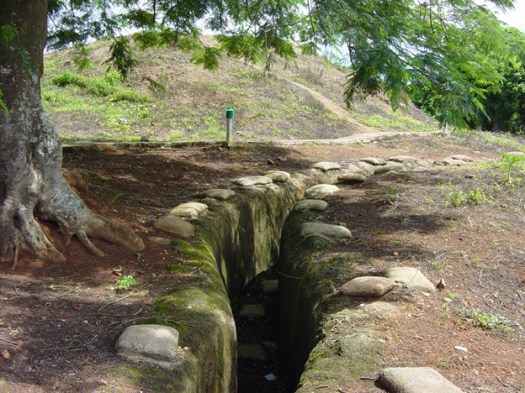
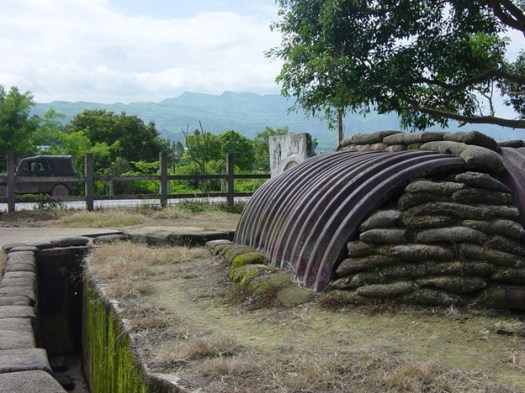
We had spent a long, tiring day exploring the war sites of the epic battles for Điện Biên Phủ. Our stomachs were empty and our throats parched as we ascended hillocks and descended into bunkers but it seemed almost profane to think of food in a place where combatants on both sides had gone for days without food or water.

As a history buff I’m always drawn to war memorials and museums. As a pacifist I’m always appalled by the senseless waste of human life. As a thinking person I’m always angered by the fact that the most vociferous supporters of war are those who stand far removed from the arenas of conflict.

Underground command post of Gen. de Castries
Underground command post of Gen. de CastriesUnderground command post of Gen. de Castries
Trenches or graves 01
Trenches or graves 02.jpg
Dien Bien Phu 01
Dien Bien Phu 01
Dien Bien Phu 02
Dien Bien Phu 02

In the photographs we’d seen that day at the museum, the only people smiling were the politicians and generals, the former invariably in white suits, while the latter were in starched uniforms that had seen neither war nor work. These were the people whose sense of timing was perfect; departing before the shells came in, or the champagne ran out.

‘To the officers and soldiers of the French Army who died in Dien Bien Phu’.jpg

‘To the officers and soldiers of the French Army who died in Dien Bien Phu’.jpgWe entered a number of stylishly furnished places we thought were restaurants. They were pubs that didn’t serve food! Alcohol, alcohol, alcohol. That was all on offer. We needed a cold beer but that could wait until we had something in our stomachs. Every place that we went into showed us only a drinks list. It was getting late and shops were beginning to close. We started walking faster and faster, desperate to eat. Eventually, we found to a restaurant; a real restaurant. We were so hungry that we scanned the menu before even sitting down. Everything was in Vietnamese and we couldn’t understand a thing.

Back in our hotel I welcomed a shower and the opportunity to get rid of the dust and sweat of a sultry, sticky day. Now it was time to make up for the breakfast and lunch that we had skipped and so we set off in search of a restaurant.

David chose something but when my eyes followed his finger, I saw the word chiên. “You’re going to eat dog?” I looked at him.

“Dog?” he asked impatiently.

Chiên is French for dog. In Vietnam dog meat is a delicacy.” He nodded, getting my point. Vietnam had once been one of colonial France’s jewels.

Almost everything on the menu had the word chiên and we tried to make the waiter understand that we didn’t want dog meat. We opened and closed our fingers to indicate canine jaws. We pointed to chiên and shook our heads. The waiter was nonplussed and the elderly man sitting behind the cash counter came over to see what the matter was.

“Bow wow, no eat,” I shook my head vigorously from side to side. He didn’t understand, lost interest and said something to the waiter, who started switching off the lights. Most places had closed by that time but luckily we found a minimart where we bought some yoghurt and crackers and headed back to our hotel room.

By the next morning my stomach was touching my backbone. David said that he hadn’t been able to sleep because of hunger. We wanted a heavy breakfast before catching our noon flight to Ha Noi. Our guide book had recommended a restaurant for the best phở – a noodle, meat and vegetable soup – in town and we headed there. The waiters didn’t understand our order for “poh” and we wondered if the cyclo driver had brought us to the correct place. It was going to be our last meal in Điện Biên Phủ and we wanted the best. There must be another restaurant by the same name nearby we thought and walked out of the place. As we were leaving David looked up and saw in big letters the word Phở.  We called the waiter out and pointed to the word and he smiled. “Fer,” he pronounced it. “Fer,” he articulated once again, slowly and clearly.

We realised our mistake. We’d had this dish hundreds of times back in Vientiane, where we lived, and pronounced it the same way. We laughed wondering why we had pronounced it differently here.

The phở was very good, no doubt about that.

While we were eating two men at the next table took turns smoking a điếu cày – a wooden pipe that looks like a variation of a hookah. With total disregard for other diners, who didn’t seem bothered anyway, they filled the place with smoke. For non-smokers like us, Vietnam can be an exasperating experience. We watched with a mixture of annoyance and fascination.

One of the men noticed us staring and invited us to take a puff. David refused politely but I, who had never ever smoked in my life, did something crazy. I accepted the man’s offer.

I went to their table and with gestures they explained what I had to do. Very hesitantly I put my mouth to the opening and inhaled but felt nothing. They tried explaining and I took another try. Then David called from the other table saying that I had to inhale deeply, taking the smoke into my lungs.

I took a deep pull and gulped forcing the smoke down to my lungs. Then my throat caught fire. I gasped not knowing what had happened. The two men started smiling. I looked around desperately and spotted the bottle of ‘mineral’ water on the table. I grabbed it, wrenched off the cap and took a deep swig.

Almost immediately, like a fire-eater, I spat the ‘mineral water’ out over the tables and on some customers. My gullet had been napalmed. I clutched my throat and pulled at my collar. David sprang up totally confused but the others were in hysterics. The man who had invited me to smoke was clapping his hands.

Suffocating, and now in deep panic, I jumped up from the plastic chair, knocking it over. I looked around for something to pour down my throat. David shouted wanting to know what was wrong but I couldn’t say anything. I was dying and death rattles were coming from my throat.

I didn’t trust anything on the tables and rushed to the toilet. I passed through the kitchen and saw heaps of dirty soup bowls in aluminum basins. Nearby was a drum filled with water. I dipped one of the bowls into the water and gargled and spat out. I did it again and again until the burning sensation had eased. I stood there, bent over the sink till the panic started to subside. Looking at the filthy water I wondered if diarrhea was to follow the scalded throat and lungs.

When I wobbled back to the restaurant, laughter broke out again. David came up to me with the bottle of ‘mineral water’.

“It’s rice wine,” he said.

Much later, we arrived at the airport and checked in. I was starving but didn’t feel like any food as my throat was still sore and my stomach queasy. We were approaching security when I remembered that I had left about $200, in Lao kip, under the mattress in the hotel. Days earlier, while trekking in Laos I had fallen into the Nam Ou River. The money had been in one of the pockets of my cargo pants and I’d put it under the mattress for safety and to dry out. I was cursing myself when the policeman at security asked me if I was carrying a knife.

“No,” I replied but he asked the question again staring at the TV monitor. He said something to a grim looking policeman who lifted my hand baggage off the x-ray machine and walked to a table. Everything was unpacked, checked carefully and left on the table. My empty bag was x-rayed again. The man at the monitor beckoned to me and pointed to something showing up in the corner of the bag.

From where I was standing, I saw the queue behind getting impatient but also interested to see what was going to happen. Terrorists being apprehended can be fun to watch. David, from inside the security barrier stood looking at me. I shrugged my shoulders at him.

Officer Grimface brought the bag back to the table, gave me an unpleasant look and then started probing the area that had showed an object inside. Standing opposite him, I noticed the stitches in the lining had opened. He tore that open and pulled out a small Swiss Army knife.

My reaction must have surprised the policeman and the passengers. I recognized the knife, grabbed and read the words engraved on it, ‘Darling Percy – Yours Forever – J…’. It was a gift, I thought I’d lost years ago.

Both policemen smiled and then Grimface showed his softer side. He asked another policeman to take over and then rushed me all the way back to the check-in counter, where the knife was sealed in a see-through plastic bag and a receipt handed to me.

We smiled at each other and I pumped his hand gratefully.

Later, when we got back to Vientiane, we found out that chiên in Vietnamese means ‘fried’.


COMMENTS

Devinder Raj

July 18, 2021 at 5:04 pm

I enjoyed reading your article. You have the touch of humor in your article.

Malaysia is going through a total lockdown. The situation is really bad. 9000 cases today.

The only interesting thing today was your article.

Devinder

Juhi Rohatgi Williams

July 18, 2021 at 5:10 pm

Love the story and its ending!!! Truly precious!

Will remain in my memory forever!!

I hope that frown is not permanent.

Juhi

Peter Stark

July 18, 2021 at 5:12 pm

Percy, I love your writing, a 50s to 60s style. Absolutely readable. Once I started I could not stop. Great story. Nice pace.

Peter

Jason Hassel

July 18, 2021 at 5:20 pm

Nice work Perce

Steve Desmond

July 18, 2021 at 5:22 pm

Steve Desmond

A really witty and good read, Percy. You most definitely should keep up your writing.

Steve

Hemanta Kumar Parmarthy

July 18, 2021 at 5:23 pm

Hemanta Kumar Parmarthy

Lovely one dear Percy. The ending was hilarious and unexpected 🙂

Your writing, needless to say, is Chivas Regal. Smooth as Silk.

Charlotte Ann Silverman

July 18, 2021 at 5:25 pm

Charlotte Ann Silverman

Amazing – I was laughing out loud, especially at the ending! Please let me know when your next piece comes out.

Duong Tran

July 18, 2021 at 5:26 pm

Duong

I love it!

Shamol Ghoshal

July 18, 2021 at 5:27 pm

Funny and very nicely written.

Jeff Mason

July 18, 2021 at 5:28 pm

Well done! A great read and obviously you had some real challenges in DBP. Your account reminded me of some experiences I had there, as well. But, your problem with the airport officials resonated with me particularly well!

DBP is the only place in 13 years of travel where I actually wrote down every item on the restaurant dinner menu. I have never seen such a collection of “wild” animals listed as entrees!

The list of authors you are associated with are most impressive and judging from some of the titles, I will be reading them with enthusiasm.

Thanks for sharing your creative effort. No doubt it has been well received by your peers! Cheers

Nidhi Asthana

July 18, 2021 at 5:29 pm

LOVED THIS: As a history buff I’m always drawn to war memorials and museums. As a pacifist I’m always appalled by the senseless waste of human life. As a thinking person I’m always angered by the fact that the most vociferous supporters of war are those who stand far removed from the arenas of conflict.

I wonder what ‘fried dog’ would be in Vietnamese.

Gerard D’Costa

July 18, 2021 at 5:29 pm

Nice writing. I enjoyed reading about your trip to Mangalore too and I’m glad that you’re doing more of it.

Patrick Singh

July 18, 2021 at 5:30 pm

Absolutely wonderful. Lovely pace. I enjoyed it thoroughly.

Barry Atkinson

July 18, 2021 at 5:31 pm

Entertaining reading…you sort of combined the history of DBP with Viet cuisine – humorous and entertaining

Melody Kemp

July 18, 2021 at 5:31 pm

I suspect I never got back to you to say brilliant… well done and how much I enjoyed your wry wit.

Peter Lourdes

July 18, 2021 at 5:32 pm

Read it in one breath. Keeps humour and ‘terror’ intermixing. How do you do it?

Jan Nerurkar

July 18, 2021 at 5:39 pm

Beautifully written. Felt like I had been a part of that trip.

Von meinem iPhone gesendet

Jason IFMT

July 18, 2021 at 5:39 pm

Hope you keep the trip as good memory!


© Percy Aaron

Phnom Penh 2004 – First Impressions

The young man in front of me was having problems. The woman at the check in counter for the Vietnam Airlines flight from Vientiane to Phnom Penh looked past him at me and said something. He turned around, saw me with only a carry-on bag and asked if that was all the baggage I was travelling with.

I knew what was coming next, having been asked this question dozens of times on flights from Bangkok to India. Allowing other passengers to use your unused baggage allowance is fraught with dangerous consequences and I was about to refuse, when his explanation came gushing out. He was going home to Cambodia after graduating from a university in China. In the five years there, he had collected a lot of books and now didn’t have enough money to pay for his excess baggage. In pre-Kindle days, books invariably constituted a large part of my luggage. I understood and readily agreed.

We checked in together because of the baggage and ended up sitting next to each other. On the flight to Phnom Penh, we chatted about student life in China and my experiences as an EFL teacher in Vientiane. He asked me why Lao students received so many more scholarships to study abroad than Cambodians. I didn’t know that but made a mental note to find out. It was my first visit to Cambodia and I started to ask him about hotels, places to eat, sites to visit and things to do but he wasn’t of much help having lived abroad for so many years.

He asked where I was staying in Phnom Penh and I said the Indochine Hotel. He didn’t know of it, but knew the location and offered to drop me there.

We landed at a near empty Pochentong International Airport and cleared immigration quickly. While we were waiting for all his/our baggage, he noticed that I didn’t have my cabin bag. I had walked off the aircraft leaving it in the overhead locker.

True, this wasn’t the first time something like this had happened. In the past – and it was to happen again and again in the future – I had left behind books, bags, wallets and mobiles in planes, trains, buses and taxis.

We hurried to a customs officer and the young man said something to him in Khmer. The official shouted out to somebody who hurriedly took me back to immigration and more words were exchanged. Then an official kept my passport and handed me over to somebody from the Vietnam Airlines ground staff. We raced back to the aircraft and pushed past the passengers who were boarding for the onward flight to Ho Chi Minh City. I went straight to the overhead locker and retrieved my bag, which by now was squeezed into a corner. The passenger sitting where I had sat asked me if the Lonely Planet guide book was mine. I thanked him and apologised to everybody around.

I collected my passport from immigration and the customs official just waved me through.

The young man smiled when he saw my bag, then introduced me to his parents and younger brother. His father said something and he translated. I was being thanked for helping his son with the baggage allowance. His father then insisted that I join them for lunch before going to my hotel. I politely refused saying that the family would want to spend time with their son whom they had not seen for many years but the young man smiled and insisted.

We drove to the restaurant in a chauffeured car with a flashing blue light on top. I didn’t pry but from the little I gathered, his father was a high level bureaucrat.

After lunch, they dropped me at the hotel and I insisted on reciprocating by inviting the two boys to dinner on any of the next couple of days that I was going to be in Phnom Penh. They accepted, said they would come the next evening but never ever got in touch again.

Phnom Penh struck me as being a bit of a wild west town. There was a palpable feeling of violence but this might have been because of its recent past. Or, maybe because of stories I had heard about its people; friendly and gentle, yet sometimes capable of great anger at the merest slight.

The feeling of sleaze was more apparent. I lost count of the number of times I was propositioned by male and female, from young children to toothless crones. I suppose that I fit a certain profile; lone male traveller of a certain dotage. Later, it dawned on me that the reason why the young man who I had helped with the excess baggage didn’t turn up for dinner was probably because he thought I was a sex tourist.

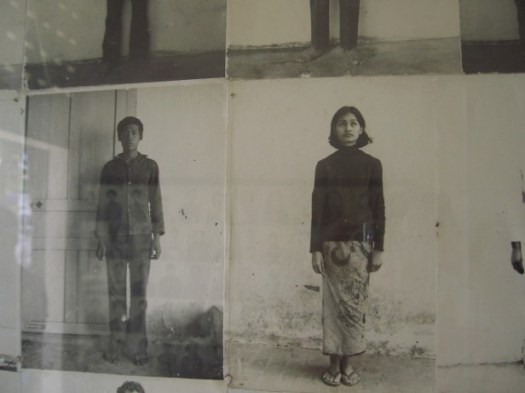
Despite the oppressive heat of those July days, I walked a lot on that first visit to Phnom Penh. I explored the lanes and bye-lanes, observing street life. Staring at old buildings, I wondered what stories lay behind those dilapidated walls. The people were lovely and friendly, and ever ready to help when asked for directions. I remember one shop keeper sending an assistant to show me a place, several streets away, where I could buy camera batteries. Yet, as a history buff, my thoughts kept going back to the barbaric years of the Khmer Rouge. At Tuol Sleng and the Killing Fields, I wondered how a gentle people could be transformed into such remorseless killing machines.

Anonymous victims – Tuol Sleng.jpg

Wiping my sweaty glasses, I remembered grimly that during the Khmer Rouge years, spectacles were a sign of being literate, and a passport to the labour camps and subsequent extermination.

Memorial of the Macabre

One day, I hired a cyclo to show me a few places not mentioned in Lonely Planet. The driver spoke a fair amount of English and I felt safe asking him questions about the past but he was more interested in talking about the present. I treated him to lunch at a restaurant he would never have been able to afford unless he won a national lottery. After the initial self-consciousness, he ranted and raged against the rampant corruption and thuggery of the ruling classes. On the road when an SUV with tinted rolled up windows muscled through the traffic, I pointed out the lack of a number plate. He turned and whispered, ‘corruption’.

Restaurant clientele were mainly western men, tankards of beer in hand, often accompanied by an underfed local girl in a low-cut top and hot pants. While the foreign men talked to each other, the girls would sit mutely beside them nursing soft drinks or chatting to the other ‘working girls’ at the table. There were numerous stories that when the UN and other international aid agencies moved in after the Pol Pot years, prostitution and AIDS soared

The poverty was apparent everywhere and as always there was the nagging feeling that quite a few people were thriving from it: the regime with some of its ex-Pol Potters, their families and friends and the foreign consultants gorging on fat consultancies. The words of Tarzie Vittachi, the Sri Lankan journalist, came to mind: ‘A foreign expert is somebody who comes to find out and leaves before he is found out’.


COMMENTS 

Juhi

June 7, 2020 at 7:18 am

Very well written. Nice you incorporated history into it!! You do have an amazing writing talent


© Percy Aaron

Shenanigans in Hanoi

It was going to be a long day. The brochure for the day trip to Halong Bay had the coach picking us up from the guesthouse at 7.00 am and dropping us back after 9.00 pm. I was running a temperature but didn’t want to cancel.

About two hours into the journey, I started feeling worse. I spoke to my friends and decided to opt out of the trip. The coach was stopped and the guide hailed a taxi. I was embarrassed that a bus full of tourists was being held up because of me but everybody was sympathetic. Probably they wanted me off the coach before things got worse. Eventually, I made it back to the guesthouse by about 10.00 am.

The receptionist hesitated when I asked for the room key. She muttered something but I didn’t understand a word of Vietnamese. The phone rang and she answered it, just as another guest badgered her. It was going to be some time before she attended to me.

I didn’t see the key for 205 hanging from the board and assumed that my room was being cleaned. I turned towards the stairs and the receptionist shouted but I had to use the toilet and rushed upstairs. The door was locked and I knocked a couple of times. No cleaner inside? I was walking back to the stairs when a sleepy middle-aged man opened the door. Ah! I thought, instead of cleaning the room, he was having a snooze. I pushed past him to the toilet and the first thing I noticed in the tiny room was that my suitcase was missing. Then a naked woman on the bed pulled a sheet over herself and started screaming at me. I screamed back, “thieves, police.” She jumped up and slapped me. I hit the man. She scratched my face. I kicked him. Pillows and shoes were flying across the room. Everybody was shouting, including the people now collected near the door.

The police arrived and I could see some people were in trouble. Not expecting me back till very late in the evening, some of the staff had rented out my room to this young woman and her customer for an hour or two.


© Percy Aaron

The hidden price of war

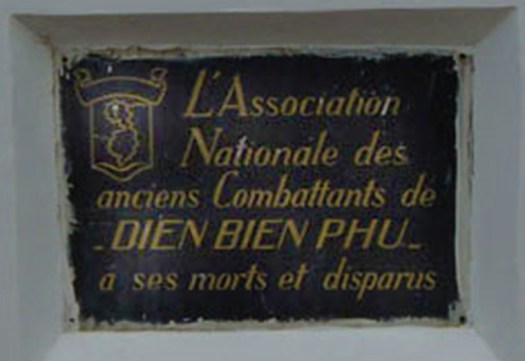
The National Association of Veterans of Dien Bien Phu. To their dead and missing

It is difficult to travel to Vietnam without encountering some reminder of its violent past. As a regular visitor to this beautiful and fascinating country, places like Hue, Quang Tri, Kon Tum, Khe Sanh, DMZ, etc bring to mind words and images of war that were part of a daily staple in my teens and 20’s. Consequently, my visits there always include the de rigueur visits to war museums and battlefields.

In the last few months I’ve visited museums, tunnels and terrain that were scenes of some of the most savage fighting in the twentieth century. All of them stand testimony to man’s inhumanity to man, to the fact that the greatest price is always paid by ordinary soldiers and civilians, and probably most poignantly of all, that all those sacrifices are forgotten with the march of time.

At the War Museum in Dien Bien Phu, two non-combat photographs taken during a lull in the fighting, struck me more deeply than any other.

The first showed women from some ethnic group serving food to Viet Minh guerrillas. The propaganda people who chose that photograph for display hadn’t noticed the look of fear and resignation on the face of the woman in front who had obviously been forced to sit on the lap of a soldier while he fondled her. Other soldiers leered at the women waiting behind her. The look of suffering and humiliation on her face struck me deeply. Truly in human conflict females always pay the greatest price. The women of the vanquished are always spoils for the victors. And when they’re from ethnic tribes or other marginalised people, they count for even less.

Whatever happened to the people in that photograph?

The second picture showed a couple of French soldiers staring blankly at the camera. The fatigue and utter despair on their faces leaped out of the picture. I couldn’t help wondering what was going through their minds knowing that they were completely surrounded and that their days were numbered. Were they reluctantly giving their lives for a cause they knew was unjust?

Whatever happened to the people in that photograph?

At the War Remnants Museum (renamed from the apt American War Crimes Museum) in Ho Chi Minh City the exhibits catalogued the murderousness of modern warfare. The high-tech barbarism of one side was being matched by the low-tech savagery of the other.

Equally moving was the exhibition of photographs taken by those who had lost their lives covering the war. None of the pictures glorified conflict.

Whatever happened to all the people in those photographs?

The only ones smiling in the photographs were the politicians and the generals, those people as far removed from the frontline as possible. Did they ever stop to think how many innocent lives would be snuffed out by their decisions, their blunders and their egos?

No leaders have the right to send their young men and women to lay down their lives on foreign battlefields, especially for causes that become meaningless a decade or two later.

When politicians wage war it should be mandatory for them to take up arms and lead their troops into battle, as rulers did in times gone by. Or they must be made to ensure that their sons and daughters are in the thick of fighting.

Then only may we spared the spectacle of a bird-brained braggart, donning a uniform he has brought shame to, leaping on the deck of an aircraft carrier and boasting prematurely, ‘Mission accomplished’.


COMMENTS

Jan

June 15, 2011 at 8:11 pm

Yet again…
a la HEMMINGWAY…
Wonderful piece, so well written, that i felt as though i was with you on that trip. Almost like our trip to Delhi….(all of 40 years ago) maybe you remember??
take care mi amigo. mucha suerte!

Jansan

Jan

June 15, 2011 at 8:12 pm

Lest I forget…
“You can’t say that civilization don’t advance, however, for in every war they kill you in a new way. ” – Will Rogers

Jansan

Jan

June 15, 2011 at 8:12 pm

In closing….
“What difference does it make to the dead, the orphans and the homeless, whether the mad destruction is wrought under the name of totalitarianism or the holy name of liberty or democracy?”
– Mahatma Gandhi
As you and your readers my see and hopefully understand….the Mahatma did ask the question.

Jansan

Jan

June 15, 2011 at 8:14 pm

The first casualty of war is innocence…

Jansan


© Percy Aaron