Sister Marie Catherine Dungmaly, A down-to-earth Saint (03.07.1930 – 12.01.22)by Percy Aaron.

Sister Marie Catherine Dungmaly

( Live Encounters Magazine Volume Two November-December 2024 : https://liveencounters.net/2024-le-mag-anniversary-editions/percy-aaron-sister-marie-catherine-dungmaly/ )

Marie Catherine Dungmaly was surely a saint.

I first met Sr Catherine, as I knew her, when a colleague asked if I would be willing to help a seventy-year-old Catholic nun improve her English. He was going back to Australia for medical treatment and didn’t know when he would be back.

I had been getting up early on Sunday mornings to teach disadvantaged children at a temple in a distant suburb but dropped out after a few weeks when it seemed obvious that the project was more about proselytization than altruism.

So, when Steve asked me to teach this nun, I wanted to know first if she was into conversions. She wasn’t he assured me, and since he was as averse to religion as I was, I agreed to meet her.

Sr Catherine was tiny bubbly nun in her early 70s. ‘Steve!’ she exclaimed, a beam across her face. Steve, a burly Vietnam-war vet bent down and gave her a big hug.

After the introductions, he told me what I had to do. And what to not do. ‘Don’t let her push you around,’ he advised. ‘She’s a stubborn old b@%!h. Give her a kick up the a@!e, when she deserves it.’ Steve was the archetypical abrasive Australian, as diplomatic as a derailed locomotive. I’d heard him swear at everybody but was taken aback that he was saying this to her face. Sr Catherine laughed, crouched in a karate position, then swung her hands to deliver a mock chop. Towering above her, he bent down and gave her another big hug. Twenty years younger than the nun, he was clearly under her spell.

Soon I was visiting Nazareth House, the home for girls aged 9 to 20 that she had founded many years before. Very quickly it became apparent that though English was her fifth language, she needed no help with it. She was fluent in Vietnamese, French, Lao and Thai and also spoke with considerable facility, Hmong and Khmu, two of Laos’s ethnic languages.

Like Steve, I was falling under Sr Catherine’s spell. Gradually my two-hours-once-a-week lessons became 3-4 hour-sessions every couple of days. The English lessons were forgotten as we chatted politics and poverty, classical music and church doctrine, culture and Communism. and a host of other subjects in between. A voracious reader, she devoured the books I borrowed for her. The French classics she lent me were way above my interest and comprehension levels and after keeping them for a few weeks unopened, I’d give them back deftly avoiding any discussions.

Her fondness for certain kinds of French cheese – she always gave me half when she received gifts – was the result of the years she had spent in France, I thought. But then her tastes in music and literature, her ability with languages and her sophisticated mannerisms, betrayed the Mandarin influence from her mother’s side. She once told me that she was distantly related to Bảo Đại, the last emperor of Vietnam but didn’t want to discuss him further.

Sr Catherine would squeal with laughter every time, I told her an anti-clergy joke. ‘I must tell this one to the bishop,’ she’d often say. When she said that she belonged to the Sisters of Charity of Saint Jeanne-Antide Thouret, I teased her that even God didn’t know how many orders of nuns there were. She was rather tickled at that comment.

As our friendship developed, I admitted to her my initial misgivings about her being into religious conversions. ‘Poverty knows no religion,’ she replied sadly. ‘Most of the girls here are from the ethnic groups. And they are mainly animists.’ Later, I would observe that it was she, who educated them about their culture and traditions.

Sr Catherine looked forward to my visits, she told me. I took her mind off the daily problems she faced finding food and finances for the fifty-five children and the twenty or so nuns and lay helpers at Nazareth House. I admitted that I too looked forward to seeing her as she had become my caffeine fix.

Slowly, our roles changed as she became my teacher: brushing up my French and helping me learn Lao. Her profound insights into various Southeast Asian cultures and her experience with the children definitely informed my teaching practices.

In the large kitchen where the meals were prepared, she showed me how to make spring rolls and vegetable soups. Often, I’d stay for lunch, sitting opposite her, while she taught me how to wrap lettuce around certain food without splattering the contents over my shirt, or how to cut fruit efficiently. I couldn’t help but notice how deftly and daintily she handled the cutlery. After a while the bland diet for octogenarians (at seventy-four, she was one of the younger nuns) soon had me making all sorts of excuses to avoid meals there.

When I asked for help with my garden, she dropped by to make an assessment. She looked around, suggested what should be planted and where and then started pulling out weeds and tossing broken flower pots into the centre of the garden. Days later, she returned with her gardener, in a dilapidated Toyota pickup filled with saplings and flower pots. She instructed the young man to chop down a large tree to its stump and seeing my expression, explained that the tree was diseased and needed to ‘breathe’. Plants were uprooted and the soil prepared. On subsequent visits more saplings were planted, flower pots arranged and the pond drained and cleaned. Three large lotuses were floated in it and orchids hung at the entrance. Within a couple of weeks, my garden was transformed into a mini rainforest.

It wasn’t only in languages, or gardening, or cooking that Sr Catherine’s all-round abilities amazed me. When I gifted her half a dozen guitars so that the children could learn the instrument, she picked up one and started strumming a few chords. I would sometimes find her in the chapel playing Bach or Vivaldi or singing one of her favourite choral pieces. Then I knew that something was troubling her and would sit quietly in the last pew until she had finished. Steve had introduced me to the music of Palestrina and I recorded some for her. Soon this 16th century composer became one of her favourites.

She sketched, painted water colours and did embroidery.

Early one morning, Sr Catherine telephoned. She had never called at such an early hour. ‘Percy, please be here for breakfast at 7.30.’ It was almost an order. I showered, dressed and rushed to Nazareth House wondering what the matter was. The children should have already left for school but they were all assembled in front of the main building, dressed in their school uniforms. The doors to the chapel were wide open and there were flowers everywhere. Had one of the nuns passed away? Inside the chapel, the older nuns were sitting in the front pews.

As usual, she was in the centre of everything, supervising a dozen things. Then a motorcade drove up and five men emerged, dressed in black soutanes, two of them with red zucchettos or skullcaps. From the last car four men in ill-fitting light blue suits climbed out. Sr Catherine shook hands with all of them, then introduced some of us. I didn’t catch any names. After mass, we had breakfast in the refectory and I gathered that the cleric sitting next to me was an Italian monsignor. The men in the blue suits stood in the doorways, one of them clicking the occasional photograph.

After the motorcade drove off, there were so many questions for Sr Catherine. She apologized for the short notice, then said that one of the men was the apostolic nuncio, or papal ambassador, to Thailand. The others were emissaries from John Paul II. The Vatican had sent a high-level delegation to negotiate with the government on granting greater religious freedom. And who were the men in the blue suits? They were the secret police, she answered. I was not too pleased about my photographs ending up in the files of the Ministry of Public Security.

Sr Catherine was implacably anti-Communist. As a young girl in her native Vietnam, she was awe-struck seeing giants for the first time: huge Africans from the French colonies, packed into trucks. She mentioned the troop movements in the village and the headman told her to be careful but report everything back to him. This she found very exciting. But her attitude to the Communists changed the day her father was put in a bamboo cage just high enough for him to crouch and displayed in the village square. He lay in the hot sun deprived of food and water. When she ran to him with a mug of water, one of the men knocked it out of her hand.

The villagers were called upon to denounce him but they refused insisting that he was a good man, ever ready to help others till their lands. For two days he lay there before being released. Later she learned that her father had complained to the headman about the excesses of the Viet Minh who would arrive at night to squeeze the villagers for their meagre stocks of rice and vegetables. That her father was a staunch Catholic, was another reason, she strongly felt. More than sixty years later, her lips would quiver when talking about that incident. Catholic good, Communist bad, was her simple philosophy. President Ngo Dinh Diem, the former South Vietnam dictator was a good man, she always insisted.

Her animosity towards Communism was not directed at individuals. She admitted openly that her work in the country was possible only because of closet Catholics and other sympathetic people in authority.

During the very difficult post-independence years, she was always ensured a steady supply of military uniforms to sew. Though there were no cash payments for the work, the rations she received in compensation were adequate to feed her nuns and others.

In 2006, at the government’s request, she opened the Luang Prabang Deaf and Dumb Centre. During one particularly heavy monsoon, the mountainous roads were blocked due to landslides and food supplies were running low. She went to see a very high official in the national airline to plead for a discount in the air-freight. The man told her furiously that the airline was not his private business and tossed the letter back at her.

She was out of the building when she noticed the red stamp on the paper with his signature: the 200 kg of rice and other supplies were to be flown to Luang Prabang absolutely free of charge. Once in Sydney, the check-in staff at the Thai counter allowed me an additional 45 kg over my allowance at no additional charge, when I mentioned that I was carrying clothes and toys for an orphanage in Vientiane.

‘I really worry when the younger girls, or older nuns fall sick late at night’, she once said. ‘They can’t wait till the morning and admitting them to a hospital at night is a big problem.’ I mentioned this to a friend who had been a professional nurse back in her country. Before the end of the week, my friend had collected medical supplies to run workshops in first aid for the younger nuns, though she insisted that they call her at any time of the day or night. Catherine, she added, handled the syringes and the IV tubes like a trained medic. Later, I learned that my friend was bringing in medical supplies in her embassy’s diplomatic bag, with the full permission of the ambassador.

Sr Catherine seemed to work her little miracles on me too. Every now and again, she would ask me to fix her desktop. My knowledge of computer hardware is limited to a little more than the ON/OFF switch. I’d tell her that I would bring in an expert on my next visit but she’d insist that I first give it a try. The problem would be solved and when asked what I had done, I had absolutely no idea. She’d dictate letters to me in French and despite my basic knowledge, there would be very few mistakes when she’d proofread.

The younger children, when not at school, were always hanging around and the five or six dogs she had adopted were like a security detail. She had to pet or talk to them before they went off wagging their trails. When we walked near the enclosure where the cows grazed, the animals would walk along the fence until she had stroked their snouts and said some words to them. Then they’d twitch their ears and trot off.

Sr Catherine wanted to attend her grandnephew’s ordination in Los Angeles and asked my help in applying for her US visa. Late one evening after work I went to Nazareth House and started the tedious job of filling in a form designed by some brain-dead bureaucrats. She sat beside me, as I read out the questions and typed her answers. Had she ever been a member of the Nazi party? No. At another question I quickly clicked ‘No’ without reading it to her but she wanted to see what it was. If a septuagenarian nun’s laugh could be described as a guffaw, then that is what she did at being asked if “she was seeking to enter the United States to work as a prostitute or procurer”. At the embassy interview, the visa officer couldn’t understand why she wanted to travel all the way to Los Angeles for just one day: It would take her longer than that to make the round trip, he tried to make her understand.

Sr Catherine was so integral to Nazareth House, that thinking about what would happen to everything when she passed, depressed me immensely. But when the government asked her to set up the centre in Luang Prabang for children with hearing and speech disabilities, she willingly accepted, feeling that her work in Vientiane was complete.

For various reasons, my worst fears, soon came to pass. Stories of what was happening at Nazareth House after her departure upset her so much that she never set foot again in that place. Years later, when she was moved to the retirement home for nuns in Thakhek, her eyes would moisten, when anybody mentioned what they had seen there. I myself, never went back to Nazareth House again, after one such visit.

Once a month I would travel approximately six hours to Thakhek, about 350 km away, to see her. After a night’s stay, I’d visit her for an hour or two the next morning, then catch another dilapidated bus back to Vientiane. The return journeys were even longer as the driver and his helper stopped to smoke, drink, stuff passengers into standing position in the aisle and even load motorbikes on to the roof of the bus. Each time, I swore that it would be my last trip down south. But Sr Catherine was waiting for my visits and the books that I would carry there. Later, it made more sense to save my shoulder from injury by buying her a Kindle and loading up about 200 books at a time to keep her occupied for a month or so.

The pleurisy and other health problems didn’t slow her down and eventually the nuns got her a portable oxygen cylinder to drag along when she couldn’t sit still. Even then she was always thinking of others. She asked me for a knitting machine and endless supplies of wool so thar she could knit warm clothes for poor people to sell for an income.

But her inability to keep working for the poor was beginning to get her down. ‘I’m ready to go,’ she’d always say, on each visit. ‘When will the Lord call me?’

One January day, I received word that she was deteriorating fast. By the time I arrived in Thakhek, she was slipping in and out of consciousness. Everybody seemed to be waiting for me and a couple of them shouted into her ear in Lao and French that I had arrived – as if that was going to revive her. I sat next to her bedside and rested my hand on her forehead, then held her right hand in both mine. As her life was ebbing away, many memories floated past. And a thought – I had had many times before – came back to me: that I had been truly privileged to have actually known a saint.

Shortly after midnight, her Lord called her.


© Percy Aaron

Percy Aaron is an ESL teacher at Vientiane College in the Lao PDR and a freelance editor for a number of international organisations. He has had published a number of short stories, edited three books and was editor of Champa Holidays, the Lao Airlines in-flight magazine and Oh! – a Southeast Asia-centric travel and culture publication. As lead writer for the Lao Business Forum, he was also on the World Bank’s panel of editors. Before unleashing his ignorance on his students, he was an entrepreneur, a director with Omega and Swatch in their India operations and an architectural draughtsman. He has answers to most of the world’s problems and is the epitome of the ‘Argumentative Indian’. He can be contacted at percy.aaron@gmail.com
What a beautiful article on Sister Catherine.
She was always smiling and welcoming to Bec and I.
God Bless her.
Gerry Quinn

Against All Odds

I cried because I had no shoes until I saw a man who had no feet – Old Russian proverb

“I see my name, country and score flashing on the electronic board and I blink many times. I have won silver for my country and myself. I have done it and I can’t believe my eyes. My wildest dreams have come true and the tears start flowing. A short while later, my happiness is tinged with sadness: my family, my friends and my coach aren’t here to share this moment of a lifetime with me. I cannot explain how alone I feel, that the people I care for the most are not here with me. The silver around my neck would have been more than gold, had they been here.”

When Phouthavong Sisavengsouk (Pim) lifted 151 kg to win silver at the 7th ASEAN Para Games, Myanmar 2014, he put to rest the disappointment he had felt at the previous games in Indonesia 2011. A miscommunication between his coach and the judges had seen him disqualified on a technicality. So near and yet so far.

I’m no stranger to broken bones and have had my leg in a cast a few times. I remember the feeling of utter inadequacy and the extreme frustration at not being able to do the things that came so naturally to people around me. Watching Pim, polio-stricken as a child, swivel his wheelchair to load a five-kilogram plate on the barbell, his ready smile and his general cheerfulness, reminded me that I had not been a very patient or pleasant person, when I had had broken limbs. I heaved a sigh of relief that I had got away so lightly.

The disappointment in Indonesia was hard to take and despite the regular visits to the gym, he became increasingly dispirited. Two years ago he met American Sam Hollrah, working out at the same gym and they soon became gym buddies. Sam, a powerlifter in his native Texas, gave Pim tips on improving his technique. More importantly, Sam got Pim to focus on the future, not on his past. “I pushed him. I didn’t let him feel sorry for himself. If he dropped something, he had to pick it up himself,” Sam told Champa Holidays.

Then the big chance came and he was given two months to prepare for the 7th ASEAN Para Games in Nay Pyi Taw in Myanmar. He wet to another gym in the evenings for a further two hours of weight training. He worked harder on his triceps and shoulders. Sam advised him to lose weight, so that he could enter in a lower category. He stayed away from sugar and alcohol and increased his intake of fruit and vegetables. The preparation cost a lot of money stretching his family’s limited resources. Pim received a small amount from the Lao Paralympic Committee but it was inadequate. The cash award of 10 million kip ($1,250) promised to him for winning the silver medal will be welcome when it eventually arrives.

Champa Holidays asked Pim what he did when he wasn’t working out, did he have other interests? He used to play basketball but that was too difficult from a wheelchair. Also, he preferred working alone. He draws when he has the time and makes handicrafts from dried coconut shells. So, was he an artist or a powerlifter? He held up his silver medal with a chuckle.

But he is not resting on that success. His immediate goal is to take part in the Asian Para Games in Incheon, South Korea in October this year but that depends on his finding sponsorship. And Rio 2016? Pim rolls his eyes and his face fills with a big smile.

Does Pim see himself retiring? No, he says, but in the future he’d like to become a trainer, working especially with people like himself. So, does he have any message for young Lao people today? He thinks for a while, then answers. “If you want something really badly, you have to work for it.” Then looking at Sam, he adds with a big smile, “ and only listen to people who tell you, you can do it.”

(Published in Champa Holidays – Apr-May 2014)

Chef Chandra – in touch with his roots

Talking to Chef Chandra Vongsaravanh is like attending a combined lecture on gastronomy, the environment, culture, history, linguistics and more. A veritable walking encyclopaedia, we were spellbound with his wide and diverse knowledge. Despite his unassuming demeanor, once you get Chandra started, his passion for taking Lao cuisine to the world is soon apparent.

While studying economics at Budapest University, he ran a restaurant during term breaks. After graduating he decided he liked cooking more than counting and found himself a job with the Marriott Hotel in the Hungarian capital, preparing a variety of Asian, French and Hungarian dishes. In 1996, he opened his own signature restaurant in that city. As his reputation spread, he was invited to take part in a number of European cooking forums and even served time as a TV celebrity chef. The Smithsonian Institute in Washington D.C. invited him and a number of other international master chefs to take part in cooking demonstrations spanning a month and a half.

He returned to Laos in 2000 with his Hungarian wife and opened his first restaurant the following year in Luang Prabang. A cooking school followed, which has seen around 30,000 enrolments. Chandra, who speaks six languages will be presenting a cooking show on Lao TV in the coming months and a cook book will be published later this year. A man of many interests, he is also the founder of the Luang Prabang Royal Ballet Theatre, Phra Lak Phra Lam.

Chef Chandra took time off his busy schedule to talk to Champa Holidays and started by emphasizing the relationship that Lao cuisine and culture has to the four basic elements: air, earth, fire and water. The Lao people were animists long before Buddhism came to the country and it is their belief in their belief in the spirits of the forest that influenced their cuisine. Lao cooking is very simple and only what is available, in season, should be used. “Nothing more than what is essential, should be taken from the trees or the earth,” he stressed.

Khao niaw (sticky rice) is the very soul of Lao food according to Chandra, and even Lao people are unaware of this. No other country has accorded such a central role to this rice. It, rather than steamed rice, is offered to the monks in the morning taak baat. At weddings, a ball of rice, divided in half and eaten by the bride and groom with arms intertwined, signifies two halves becoming a whole. Sticky rice is never thrown away but instead left outside for the birds, he said.

Our lesson in gastronomy segued into history. “Hundreds of years ago, large parts of northeastern Thailand were part of Laos. The food, language and culture were the same.” After the war on Vietnam, the Lao diaspora increased and many needed to earn a living in their adopted countries. Some opened ‘Thai’ restaurants, since Lao cuisine was unknown. While Thai food increasingly popular, diners were unaware of the difference between Isaan cuisine and Thai mainstream dishes. Chandra’s mission is now to rectify that misconception and see that due credit is given to Lao food.

“Anything that is not natural, destroys the organisms of the body”

 Since the environment and the elements are so integral to Lao cuisine, we asked Chandra what he thought about the increased use of chemicals in agriculture and galloping global deforestation. “If you look around the region, China, Vietnam, Thailand, all their forests have gone. Here in Laos, we still have some forests. We must protect them.” He agreed that this was a matter of grave concern that needed to be addressed without delay. The indiscriminate use of agrochemicals worried him, as biodiversity is critical to food supplies. Every insect plays its part in rejuvenating the environment. He is also alarmed by the rise in fast foods and additives, something that is completely alien to Lao culture.

(Published in Champa Holidays, Feb-Mar 2014)


© Percy Aaron

A Man of his Words

“Are you Burenang?” the burly plainclothesman asked, referring to me by my pen name.

“No,” I lied.

He sensed my fear. From his pocket he pulled a pamphlet I had written and stared at my picture below the text. “You chose,” he hissed, “your life or your writing.” A few feet behind, stood his partner. Under his loose shirt I could see the outline of the gun in his waistband.

Bounthanong Xomxayphol’s first brush with the royalist authorities, came when he was only 20. He was certainly intimated but not deterred. He continued to write, changing his pen name or moving from house to house whenever he sensed danger, or a sympathizer in the police tipped him off. The war was going badly for the royalist government and though the pressure eased, he was always a target.

The Vientiane of the 60s and 70s was a frontier town. The American War on Vietnam flooded across Lao borders and the capital filled with foreign soldiers, merchants and mercenaries, who played alongside the French colonials and their local supporters. Anything and everything was for sale, especially guns, girls and drugs. The majority of the people remained mired in deprivation and exploitation.

Bounthanong was passionate about books and words came easily to him. So, the decision to become a writer was inevitable. It was the best way, he felt, to catalogue the injustices he saw all around him.

He told Champa Holidays that he was probably one of the few Lao, who as a child, had his own library at home. An avid reader from an early age, he was profoundly influenced by the works of the short story writer, Outhin Bounyavong and the poet Panay (Pakien Viravong). Later, it was Guy de Maupassant, Victor Hugo and O. Henry.

After high school, he went to the Royal Institute of Law and Administration, becoming an active member of the Lao Progressive Students Association. He wrote a series of articles in the student newspaper denouncing CIA activities in Indochina. In 1973 he had printed 1,000 copies of The Bright Side of Darkness, his first collection of political articles, essays and short stories and sold them outside schools and theatres. This resulted in that first visit from the secret police with the warning to choose between his art and his life.

“I am not a fly that travels around collecting news of other people to report to the powerful in the hope of collecting a reward…I have no wish for this land to have any more cowards than it already has.” 

  • A Bar at the Edge of a Cemetery

Gorbachev’s glasnost sent ripples beyond the Soviet Union, and this eased some of the restrictions But, the more things changed, the more they remained the same. Writers, by the very nature of their profession, are outsiders and if they wish to remain objective, they must stand aloof from the society they chronicle. This brings on its own set of problems and to avoid these, some collaborate, while others adapt or allegorize.

“Oh you men! What a life a poor bird has! I harmed no one. All I wanted was for to live.”

  • Oh! Men….May I breathe

 In 2011, Bounthanong received the Lao Top Artist Award from the government. Three months later, he won the SEA Write Award for his short story Kadook America (American Bones), a powerful anti-war tale of a Lao-American team searching for the remains of U.S. servicemen missing in action during the American War in Vietnam.

There was no medicine that could cure his anger whi8ch had remained a lingering disease in his mind. During the past few days, however, he had been forced to suffer the imaginable. Here he stood digging up and sifting through the dirt, not to search for gold, but rather the bones of American soldiers, the same people who ten years earlier had arrived in Laos to murder his own parents and relatives.

  • American Bones

Earlier this year, Bounthanong earned another laurel when he won the Mekong River Literature Award (MERLA) for his novel Fai Noom (Young Fighter). Champa Holidays asked Bounthanong about his writing schedules. Despite having written about 150 short stories, over 100 poems and 4 novels, he has no fixed routine. He reads a lot and writes only when he has an idea. Otherwise, he spends his time sipping freshly brewed coffee, puffing on strong cigarettes, and observing, in the way writers do.

(Published in Champa Holidays – May-Jun 2014)


© Percy Aaron

When was the last time in your life………. ?

0001

‘When was the last time in your life, that you did something for the first time in your life?’

The punch line from a commercial that caught my eye always left me thinking that my answer would be, ‘A long time ago’.

With that in mind, I told my friend Mieko that my life was getting boring and asked if she would join me in doing something ‘exciting’.

“Something exciting? Like what?”

I explained that I wanted to get deliberately lost, to go somewhere without knowing where I was going. In Vientiane, one option to do something like that was to take a public bus where it would not be necessary to tell the driver or conductor one’s destination as fares were fixed irrespective of distance travelled. Mieko laughed as she had once taken a bus to Ban Pako, a resort in a quiet village outside Vientiane and she always wanted to travel in a public bus again. Not knowing the destination seemed like a fun idea.

So, one Sunday morning she picked me up and we drove to the Lao Plaza Hotel, where she parked her car and then we walked back the central bus station in Talat Sao.

There were a number of buses waiting to leave and we walked to one furthest away from everybody. It was rather dilapidated and we approached it from the side so that we wouldn’t be tempted to read its destination and boarded. We chose the least rickety seats and settled in. Some passengers got in after us and slowly the bus began to fill. After about thirty minutes, it set off with about a dozen passengers on board.

We drove through central Vientiane, past the Lao Plaza Hotel and headed towards Wattay Airport. After a while, we passed the airport and turned into Sikkay district, heading up the road to Luang Prabang. Slowly the haphazard sprawl of shop houses, beer shops and open air markets gave way to isolated bungalows, small vacant plots and paddy fields. The bus turned off the macadamised road and drove over an area of very red earth, past some low hills. Two or three excavators were churning up the land. It was a hot day and with the windows open or broken, dust swirled through the vehicle.

As the bus wheezed and swayed over the dirt roads, passengers boarded or alighted. Unlike in the city, everybody chatted to each other sometimes shouting out greetings to people at the other end of the bus. We had left the bus station about two hours earlier and in a small city like Vientiane that was a lot of travel time. The terminus couldn’t be far off we thought, yet the number of passengers didn’t decrease. In fact, they seemed to be increasing. We joked that maybe we had caught the bus to Luang Prabang, more than 300 km away.

Soon it was past noon and we were hungry. We did pass the occasional roadside shack displaying grilled chicken and other animal entrails covered with dust. As always, the ubiquitous yellow and green Beerlao hoardings guaranteed that we would never die of thirst.

The driver kept looking at us in the rear-view mirror. Passengers came and went and he must have noticed that the two foreigners sitting in the middle were the only persons left from the start of the journey. When he next stopped to let some people off, he turned around in his seat and asked, “pai sai?” (Where are you going?).

I rummaged in my pocket for the piece of paper where I had scribbled the Lao word for ‘terminus’ but before I could read it, Mieko answered, “baw hu.” (don’t know).

The driver stared back at us and some passengers turned around to look. It was obvious he couldn’t believe what he’d heard. Some of the passengers tittered. I was sure they were thinking: ‘Crazy foreigners get on this bus without knowing where they want to go’.

He rattled off some more in Lao and then seeing that we didn’t understand, asked us in very passable English where we wanted to go. When we replied that we didn’t know and it didn’t matter, he repeated that to the passengers. Now everybody looked at us. There was open laughter.

Baw pen nyang,” (don’t worry) he said to us with a smile on his face. ‘This is last stop. Now bus go back to Vientiane. I take you to Talat Sao.’

He was even more confused when we got up and headed for the exit, explaining that we didn’t want to go back, that we were going to get off. We were starving and had spotted a restaurant about fifty metres back. Some of the other passengers gesticulated at us to sit down but we pointed to the restaurant and made signs that we wanted to eat. The driver then told us that there would be a bus every hour and that the last bus would come at 5.30 pm.

0002

We got off and walked back to the restaurant. We entered the gate and saw a large open space with about a dozen crudely-made thatched bamboo salas set a distance from each other.  In the centre of each was a low bamboo table with a couple of cushions strewn around. Some distance away from the salas was a long single storey brick building with a number of bolted doors.

Mieko headed off to the toilet and I examined the different salas to see which was the cleanest. I had barely sat down in one when I was surrounded by about four or five heavily made up young women. ‘Beerlao’, I said and they smiled. I gestured for a menu and one of them went off to bring one. There were big smiles on all their faces and I thought them the friendliest waitresses in the world.

Mieko returned and the women looked at her sourly and walked away. We waited for about twenty minutes but neither the beer nor the menu arrived. I went in the direction of the hut I had seen the women go into and saw them watching a Thai serial. Again I asked for beer and pointed to the stack of menus on a dusty table.

0003

The place was dirty but we were ravenous. We thought it safer to order grilled chicken – standard fare in most Lao eating places – but all they had was boiled chicken, jeo (a kind of dip) and sticky rice. They didn’t even seem interested in attending to us. Of course, the Beerlao was plentiful. About an hour later, the chicken arrived and though it was insipid at least it was freshly made. We left the rice untouched.

Much later a Toyota Land Cruiser drove in and a couple of very drunk men got off. The women who had abandoned us earlier, swarmed around them. One man put his arm around a girl’s waist and staggered towards one of the locked rooms. The others, talking at the top of their voices headed to another sala.

It was obvious the kind of a place we had come to.

The last bus didn’t come till about an hour past its scheduled time. Dusk was beginning to settle and I wondered how we were going to call for help when we didn’t even know where we were. Finally, the bus did arrive. We were starving but laughed off our experience. After all, we had wanted something ‘exciting’. It was only when we were returning by a completely different way that we realised that the bus was on a circular route and that was why in the afternoon we hadn’t reached a terminus.

We never did find out where we had spent that Sunday, nor did we try.


COMMENTS

Juhi Rohatgi Williams

April 28, 2020 at 7:18 pm

Very well written Percy!! Love the story. This story is so you! I know you love exciting adventures. Reading this blog led me to think of several others.

Anne-Marie Rouleau

May 10, 2020 at 10:16 pm

Your stories were a real pleasure to read. They have the relaxing pace of the “bo pen yang” lifestyle which I enjoyed very much. I think you need to be careful which bus you get onto next time……. Keep writing, sounds like you have been having some really fun adventures. I like the way your experiences cover both happy and more tragic moments, a snapshot of everyday life which is always unique.

Hubert Barennes

May 13, 2020 at 1:37 pm

Hi Percy, I remember when you told me your escapade with Mieko!
Nice story indeed! Keep going. A pleasure to read you. You are very talented. Warm regards.

Dodo Phunyathiboud

November 2, 2020 at 1:03 pm

This is great story. Now I know why you always tell me to travel. It will give me lot of experience and one day I will do like you.

Bee

November 6, 2020 at 5:37 pm

This is a good story one. It gives us an experience and a lesson too. I think that I would like to go somewhere very very far away but now I should think again. 😅

Deng

November 13, 2020 at 8:23 am

It is a good story and worth the read. This teaches me to explore new experiences in life, and not worry too much about consequences, just focus on the present like the two people in the article. The fun was in the journey, not in the destination. In the end both of them had fun and enjoyed their trip

Anong

February 22, 2021 at 5:15 pm

I wanted to laugh after reading your story! Thank you for sharing your travel experiences.


© Percy Aaron

Wat an Experience!

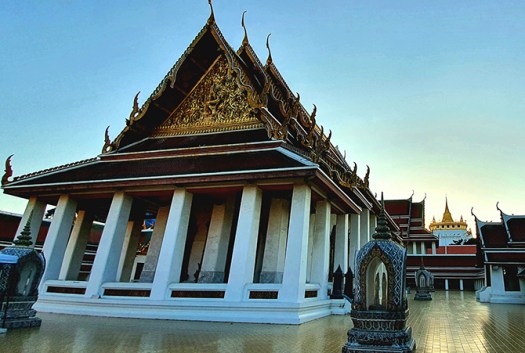
Wat Saket, Bangkok. © Photograph by Phra Nic.

(A version of this article appeared in Live Encounters, October 2021: https://liveencounters.net/wp-content/uploads/2021/10/Live-Encounters-Mag-Oct-2021.pdf)

Itthiwat Suchaianun – Nic for short – considers me his older brother. We hit it off the first time we met in Bangkok two decades ago. An epicure to the core, he took great pleasure in showing me the city’s culinary delights, not to be found in any of the over-hyped tourist literature. Later, I dared not transit the Thai capital without spending a few days in his upmarket apartment waiting for him to finish work, before we explored yet another eatery, sometimes on an overcrowded pavement. My house in Vientiane was similarly always open to him.

I usually wake up at dawn for coffee and a blank stare at the trees in my garden. When Nic was visiting, I’d find him up even before me, shawl draped over his shoulders, eyes closed and sitting in a lotus position as immobile as a Buddha statue. It was he, who stirred my interest in meditation. Therefore, when he suggested that we spend a few days in the temple where his brother was a senior monk, I jumped at the opportunity.

So, one midweek, I crossed into Thailand and he picked me up at the border. After lunch in Udon Thani, we set off for at Wat Tham Sahai Thammachan Nimit, in Nong Saeng District, some 37 km southwest of Udon. It was mid-August and the monsoons had the surrounding countryside in a lush green. We arrived in the late afternoon and before entering the temple grounds stopped to have a last meal. There would be nothing to eat until breakfast, Nic said.

At the temple, Ajarn (respected teacher) Dang, Nic’s younger brother, was waiting for us. The first thing that struck me was the beatific expression on his face and the big smile that covered it when I was introduced as his older brother. After Nic had filled him up on some family news, he took us to a two-storey dormitory, where visiting pilgrims spent the night.

The large hall on the first floor had dozens of mats and bedrolls stacked in one corner. We unrolled two mats away from the doors, then left the bedding and our bags to stake out our spots even though it was midweek with just two or three other pilgrims. Outside, there were about 5-6 communal toilets and after showering, we changed into white cotton pyjamas and collarless shirts, slipped into flip flops and headed for the meditation hall.

Leaving our slippers outside, we entered a large darkened hall that appeared to be full of statues, spaced equally about 2-3 feet apart. As my eyes adjusted to the dim light, I saw that they were in fact monks in dark brown robes. I nodded at the nearest clean-shaven heads but they didn’t even seem aware of my presence. Like a cemetery at midnight, the atmosphere was one of unbelievable stillness. We might have been the only two live beings in the hall.

Nic sat down on a cushion and I next to him. He crossed his legs in a full lotus position and though I tried the same, I managed, at best, a ten-percent lotus. My heels were a distance from my buttocks and my knees level with my shoulders. I hugged my legs to avoid toppling over, then closed my eyes and struggled to be comfortable.

After a few minutes. or was it seconds, my hamstrings started hurting. A gradual pain crept up my lower back. I shifted positions, then shifted again and yet again. I put my palms down on the mat, straightened my back and tilted my head backwards to relieve the pain that had now reached my shoulders.

Somebody seemed aware of my constant shifting because cushions were tucked under both my knees. Eyes closed, I nodded a thank you. When I felt the person move away, I opened my eyes slightly and saw that it hadn’t been Nic. He had already turned into stone. The cushions made it so much more comfortable but after another twenty minutes or so, my knees, thighs and back started hurting again. I put my feet flat on the ground and started hugging my knees arching my back to relieve my spine.

As taught in vipassana, I tried observing and accepting the pain in my limbs. That only sharpened my awareness of the sorry state of my rusty joints. I arranged and rearranged my knees and my feet again, and again. Soon my silent saviour came back and slipped larger cushions under both elbows. With cushions under my knees and elbows, it felt like a luxury car. I pushed my knees down and slowly managed a twenty-percent lotus. For about the next ten minutes or so.

Then the skies opened up. The rain lashed down on the dense foliage outside and on a corrugated roof nearby it sounded like the kettledrums of a hundred symphony orchestras gone berserk. The winds howled and the thunder was deafening. Even with my eyes closed, I could see the flashes of lightning. Through all of nature’s fury outside, the calm inside was undisturbed. I opened my eyes and gingerly used both hands to stretch each leg, careful not to kick the monk in front. I stole a glance at Nic but he was still in stone. The little voice of capitulation, or common sense, urged me to leave. Eventually, when the circulation came back to my limbs, I got up and left the hall silently. Outside the rain was pounding the wooden stairs, bending the smaller branches and bushes. The flashes of lightning were like strobe lights in a Bangkok bordello. I love the monsoons and stood watching the rain for a long time.

Eventually Nic came out and taking a large umbrella from a nearby stand, we made our way back to the dormitory, our squishy flip flops splattering mud on to our pyjamas. After another shower and change of clothes, I opened my mattress, stretched my legs and massaged my knees. Tired and hungry, I asked about dinner but Nic reminded me that in this wat, the only meal was breakfast at around 7.00 am!

Famished and fatigued, I soon dropped off to sleep. Nic awakened me at about 4.00 am. I thought he was crazy but the others in the dormitory were up already. He explained that we were going to drive to a village about four km away for taak baat, the early morning ritual of alms-giving.

When we arrived at the village, we joined the locals in setting up trestle tables on one side of the narrow country road and laying out the food. There were Oreo chocolate biscuits, sponge cakes, dried banana chips, coconut sweets, sticky rice and a variety of other unhealthy snacks. No wonder I thought, monks in Thailand were having major health problems. Nic tasked me with handing out small tetrapaks of Lactasoy.

Soon the monks approached, single file, stopping at each person to collect an offering. I hastily dropped a tetrapak into each monk’s aluminium bowl and managed to click a few pictures. When all the monks had their bowls filled, they chanted a prayer and walked away. We got into the car and raced back to the wat.

We showered and went to the large refectory, waiting for the monks to come back with the food collected. Soon the hall was full with monks and lay people. As is the custom, many poorer locals were there for a free meal. The monks sat in one section, while the rest of us – the faithful, the freeloaders, Nic and me, occupied the other side of the room. Each of us grabbed an aluminium bowl and tablespoon and then sat on the floor, in two lines facing each other. In the space between, the food was passed along in mid-sized buckets. Nic advised me to fill up as there would be no food till the next morning. I have a small appetite, and despite the warning, took just an orange, a banana, and a boiled egg.

The rest of the day, we spent cleaning the temple grounds, which were in quite a mess after the previous evening’s storm. Nic went back to meditate but my knees and back needed more rest. There were no restrictions on pilgrims chatting and when I needed a break from Nic, I read.

That night I went to bed earlier than usual, to sleep off the approaching feelings of hunger. Outside, the deluge started again and I was awakened a couple of times by thunder and the incessant rain.

The next day was like the previous day; sweeping pathways and carrying away fallen branches. Every time, I took a reading break, I realised that my attitude wasn’t in keeping with the spirit of selflessness, the others were displaying.

By the early evening my stomach started to touch my backbone. I asked Nic for some of the snacks stored in his car but he pleaded with me to resist the urge to eat. Fasting would enhance the wat experience, he said. By about 8.00 pm, the hunger pangs made me feel faint and I decided to go to bed. Then, as in the previous night, the heavy rain started again. It was impossible to sleep with the thunder and the noise of rain pounding the branches outside the window. Lying awake, increased my ravenousness.

Then an idea came to me. I went to the toilet and came back closely observing Nic. I heard the soft snore, then got up and went downstairs to his car. I gently pulled the handle of the backdoor. It didn’t open but to the sound of the thunder and heavy rain was now added the screeching of Nic’s car alarm. I didn’t think twice. Racing upstairs, I slipped into bed and pulled the bed sheet over me. For a while, all I could hear was the sound of the alarm rending the night. Eventually, I got up shook Nic and told him about the car alarm. He listened for a while and then went downstairs to check. By the time he returned, I had pulled the bed sheet over my head, adding a gentle snore for effect.

The following morning Nic negotiated the narrow road to the village, careful to avoid the slush on both sides. During the taak baat, I waited for the opportunity to slip a packet of biscuits into my pyjama pocket but imagined Nic keeping an eagle eye on me. My flip flops, caked in mud, added to my misery.

The intermittent rain of the last two days had left the hilly dirt road slushy and on the way back to the wat the tyres lost their grip and the car began sliding backwards. As it came to the edge of the road, fearing it would turn over on my side, I jumped out landing in a ditch. Nic swung the steering wheel around and managed to bring the car to a stop with the front wheels still on the road.

I was less worried about the car sliding down the hillside than missing breakfast. Luckily about a dozen local people came to help us. They put heavy branches, planks and bricks under the rear wheels and with great effort managed to heave the car back on the road.

The monks had heard of what had happened to us and breakfast was delayed. We hurriedly showered, changed into clean whites and went to eat. This time, I was not going to repeat yesterday’s mistake. I piled my bowl with sticky rice, a chicken leg, cucumber, morning glory and chocolate biscuits. Over all this I poured some bamboo soup. The ice cream came around and I tossed two scoops over the soup. But the dessert, the soup, the vegetables and the now soggy biscuits made an unpalatable mix. It looked terrible and tasted worse. I retrieved a banana and left the rest.

By the late morning the weather had cleared and Nic and I sat in a clearing soaking up the sun. In the afternoon, his brother took us on a tour of the vast temple grounds. We walked up a narrow path until we came to a tiny solitary shack at the top of a hill. With a panoramic view of surrounding area, we sat on the ground and discussed Buddhist philosophy. Occasionally, we talked yoga and Ajarn Dang folded and twisted his body to explain certain asanas. I can swear his bones were made of plasticine. He made some comment and I realised that he had been the one who had slipped the cushions under my knees and elbows the first night at meditation. We were leaving the next morning and he asked me if I would like to spend the last night meditating alone in the hut. I declined the offer but would later regret it immensely.

The next morning, at the taak baat we emptied the car of all the remaining food. Later, at breakfast, I had just a ball of sticky rice and a banana knowing that by noon we would be in Udon Thani having a proper meal. After breakfast, we packed and went with Ajarn Dang to pay our respects to the chief abbot and leave a small donation.

That Sunday afternoon, we caught up with other friends in Udon for lunch. I ordered fried pork with basil and steamed lemon fish, two of my favourite dishes. But when the food came, the sight of the meat made me want to puke. I pushed away my plate, all hunger gone.

Back in Vientiane the next evening, I still hadn’t eaten anything since breakfast in the wat. Incredibly, almost 36 hours later, I still wasn’t hungry.


(A few years later, Nic gave up his business and became a monk. Today, he is known as Phra Nic.)


COMMENTS

Jan San

January 23, 2020 at 7:31 pm

Well written and interesting read.

Juhi Rohatgi

April 21, 2020 at 6:13 pm

Beautiful and vividly written! Very interesting!

Subhash Bhargava

April 23, 2020 at 11:58 am

I read your story. A fantastic read. Thanks.

Subhash

Hemanta Kumar Parmarthy

April 23, 2020 at 12:01 pm

‘My mentor, when I was writing the Telugu travelogues, told me to write as if I am narrating to a person sitting in front of me. Your blog did that. I was with you right from the word go and lived with you every moment till you returned to Vientiane. Need I say more!

It was an excellent read. Thank you so much!’

Hemanta

Melody Kemp

April 23, 2020 at 12:02 pm

It’s good but it could be fabulous..

Melody

Devinder Raj

April 23, 2020 at 1:34 pm

I found you article very interesting and informative. Once started, i read it to the end.

Devinder

Peter Lourdes

April 27, 2020 at 3:24 pm

Well written piece. Easy to read with a realistic vision of the Meditation world.
I’d prefer the ending to be either in tune with the meditation world OR a sudden, unexpected break away

Phra Nic

May 7, 2020 at 9:15 am

I was glad to read your article and honestly felt great being in the story. You are a good writer and write so vividly. Now I look forward to good novel from you. I learned a lot of new words even though I spent more time to open dictionary. I think my English is too rusty after joining the monkhood.

Adele Rouleau

May 12, 2020 at 6:36 pm

This is great storytelling. The story is engaging and I find that you have a great ability to capture simple moments in the most entertaining way, I found myself intrigued and wanting to know what happens next on more than one occasion. The website almost feels like the cross between a travel blog and an intimate diary in the likes of Evelyn Waugh or Ernest Hemingway. Thank you for sharing your experiences, they make us wonder what kind of adventures you will get up to next.


© Percy Aaron

Cafe Chagall

It was around 6.00 pm, when my friend Hak, her son Kita and I walked into Swedish Bakery for an early dinner. We were scanning the board displaying the menu when Hubert called. He suggested dinner together and since he lived just about 100 metres away, I invited him to join us. Hubert, one of my closest friends is an epidemiologist and I edit some of his papers that are published in professional journals. He is also an epicure, much spoiled by the terrific cooking of his lovely wife, Fitiava. I almost sensed him turning up his nose at our choice of an eating place.

“Let’s go into town,” Hubert said, “I’ve been working all day and I need to stretch my legs.” Without waiting for an answer, he added, “I’ll pick you up in 15 minutes.” We cancelled our order and walked out of the restaurant.

Soon Hubert, Fitiava and their youngest son, Tristan, drove up and the three of us climbed into his Toyota Land Cruiser. On the way into town we discussed what we should eat and where. Hubert suggested that we should try a restaurant that neither of us had ever eaten in before and I agreed. He parked his car along the Mekong and we walked up and down the narrow streets in the city centre.

If I mentioned a place, Hubert had eaten there and vice versa. We turned right and we turned left, we went straight and we turned back, looking at every restaurant we passed. There were some that neither of us had eaten in but without a second thought, we just walked past.

The women and kids trailed behind us, laughing at our indecisiveness. As they began to tire, amusement started giving way to irritation. We were back on Fa Ngum Road along the Mekong, when we came across a sign “Café Chagall” with an arrow pointing down a narrow lane. Hubert and I looked at each other and agreed immediately. It must have been new because neither of us had even heard of it before. I was particularly surprised because at the end of the lane was one my favourite restaurants, which I frequented regularly.

We turned into an old French colonial house with a well-tended garden and lots of potted plants at the entrance. We were greeted by about a dozen attractive women standing in a line, beautifully dressed in a range of colourful kimonos. They said something Japanese in unison and bowed low. We didn’t understand and so a few of them giggled, “Welcome.” They parted in the middle and an older equally attractive and well-dressed woman stepped forward. “Greetings. Welcome to Café Chagall.” She smiled at us two middle-aged men and asked how many of us there were. Hubert told her and I thought her smile changed slightly when two women and then two teenagers followed us in.

As we were ushered into a large private room, I looked around. The restaurant was very elegantly furnished, Japanese minimalist style. Six women pulled the chairs back for the six of us, then handed us cold towels and poured green tea. It was still early in the evening and the restaurant was empty and I presumed that was the reason why so many women were attending to us.

“A French name for a Japanese restaurant,” Hubert remarked and then said the same thing to Fitiava in French. We looked around at the décor, the large number of people waiting on us and in hushed tones made various observations. Then the six women re-appeared and handed the six of us a menu each. I have no recollection after that of what I read, except that a plate of rice, the cheapest item on the menu, was $4. Something was $89! An odd price; not quite $100, but getting there.

I turned to Hak and whispered to her to take away the menu from her son. Across the table, Fitiava did the same thing to Tristan.

“Should we leave?” I asked Hubert, but we were too embarrassed to do so, after having used the towels and sipping some of the tea.

Hubert and I took the easy way out, leaving it to the two sensible women to save us from having to do the washing up and the mopping of floors later.

Fitiava and Hak, matched the minimalist furnishing with some minimalist ordering: three plates of rice, two plates of sushi and two plates of tempura. The woman taking our order must surely have thought that we were on strict diets. I glared at Kita when he asked for a mango juice and Hak over ruled him, asking for just plain water. Hubert, who likes a good wine with his meal, skipped that, and though my throat was parched, I decided that a cold beer could wait for another day. I had about $200 in my pocket and hoped that Hubert would have something similar.

The food came and the servings were minimalist too. By the time the plates were licked clean, I was hungrier than when we first came in.

One of the women asked us if we would like some dessert and I, of the famed sweet tooth, shook my head vigorously.

The bill came and the waitress handed it to Hubert. I took out my wallet ready to kiss hard-earned money goodbye. I asked him the amount but he wouldn’t tell me. “It was my idea to come here,” he said generously and then even more generously paid the full bill. I was embarrassed as I saw a bunch of 1,000 baht notes slipped into the leather folder and handed back to the waitress.

As we left the restaurant, now filling up with older Japanese men, some of the women lined up and bowed at us. “Sayanora” they chanted.

“Sayonara,” I replied, bowing exaggeratedly low. A thought crossed my mind; I had eaten there twice that day – the first time and the last time. Within fifteen minutes of leaving the Café Chagall we were in an Italian restaurant ordering pizzas, wine and cold beer. And later tiramisu too.

A few days later, I told my Japanese friend about the Café Chagall. She laughed. “That’s where the rich Japanese businessmen go for the “phu sao” she said, using the Lao word for girls.


COMMENTS 

Jan Nerurkar

October 11, 2017 at 12:46 am

Finally you have become an accomplished writer!! Nice read. Let me know when you have time for a chat.

Von meinem iPhone gesendet


© Percy Aaron

The Cop and the Crook

Inside the bedroom, the only place air-conditioned in the flat, the three of us sat on what must have been a bespoke giant-sized bed, whisky glasses in hand.

On a chair, with his feet up on the bed, sat the host, a likeable but dodgy businessman in his early 30’s. He made a fortune from buying and selling used luxury cars, switching original parts for clever fakes, knowing his nouveau riche customers wouldn’t know better. With the tight import controls in the country, genuine auto spares were priceless on the black market. He had invited me over to dinner, with the promise that he would settle a long outstanding bill.

On a pillow at the top of the bed, in a lotus position, sat the strikingly handsome deputy commissioner of police, reciting Urdu couplets. He prided himself on being more a poet than a policeman and was looking forward to retirement when he could write poetry full time. Diagonally across the bed, occupying most of the space, lay an attractive voluptuous woman, quite obviously his lover. In her late 40’s, she oozed sexuality and self-confidence. I sat between her and the host on the chair.

My elbow still hurt from earlier in the evening. The policeman, quite high by that time, had boasted that despite being decades older, he was the strongest and fittest in the room. Then, he had grabbed the host in a martial arts hold and tossed him onto the bed, sending a bottle of Scotch crashing to the floor. Then he grabbed my hand but I managed to pull free, roll off the other side of the bed and dodge him.

Close to midnight, the cook-cum-caretaker announced that dinner was ready. Eating at the midnight hour and then straight to bed, is quite typical in India. The others headed for the dining room and I went to the attached toilet to throw some water on my face. Midnight and the malt were showing their effects on me.

The rest of the flat wasn’t air-conditioned and when I left the bedroom, I pulled the door shut to keep the room cool. Despite the eleventh hour and the eleventh floor, it was humid and stinking hot. I asked the host why he didn’t have the whole flat air-conditioned. He replied that he was here only for a couple of days each month. Though he lived in New Delhi, he maintained this flat only for his business visits to the city.

Dinner was delicious but hurried because of the discomfort. After the meal, we headed back to the bedroom but the door was locked unwittingly, because of me.

The host had an early morning flight back to Delhi and it turned out that his keys, ticket and other documents were in his attaché inside the room. So was my cash.

We rattled the door knob and banged at the door but it wouldn’t budge. The cook brought out a long thin knife and tried picking the lock. I got the feeling that he had tried this a couple of times when the owner wasn’t around.

Then the Deputy Commissioner of Police had a solution.

He called Lal Bazaar, the police headquarters and spoke to somebody. Then he asked the cook to go downstairs and summon his bodyguard. Soon, a large moustachioed policeman in khaki followed the cook into the room, hand resting on his holster. He received some instructions from his boss, then bowed, a little too obsequiously, and left.

About an hour later, the bodyguard and another policeman returned with a blindfolded and handcuffed man between them. The blindfold was pulled off roughly and the lock breaker was shoved in front of us. The deputy commissioner gave the man some instructions and one of the policemen handed him a dirty bag. The man took some instruments out and walked to the locked bedroom door. Within minutes he had it open.

I sat there in disbelief, more at the open camaraderie between the lock breaker and the police escorts.

When he had finished opening the door, the lock breaker came back to the deputy commissioner and touched his feet. He insisted that he was in prison despite his innocence; that he had been drunk and had entered the wrong house by mistake. Then he tried a different story; that his wife and her lover had framed him.

The deputy commissioner looked at all of us. He reminded the lock breaker that everybody in the room – the host, the guests, the police escorts and the cook had just witnessed him committing a break-in. The policemen laughed as they blindfolded the trembling man and led him away.

Then calling the cook, the deputy commissioner told him not to try opening any doors in the flat, when the owner was away. For him, it wouldn’t be prison, he warned, but crushed knuckles.


© Percy Aaron

Shock Therapy

It’s the second week of the teacher-training course and the instructor walks around the class, shaking a cardboard box in her hand. “Today, we’re doing an activity called shock therapy. Inside are slips of paper. Each slip has a single word on it. When I call your name come up and choose a slip. You will then have one minute to prepare a two-minute talk on the topic you get.”

Immediately, we deluge her with questions: inane questions; hypothetical questions; obtuse questions. We’ve been taught to encourage our students to ask questions but we’re not playing that role now. We’re doing it solely to waste time. It’s an hour to lunch and we’re trying to avoid this silly activity. It occurs to me that one day our students are going to try the same stunt with us.

The first person walks nervously to the front, picks a slip from the box, opens and reads it. She looks at the ground for a minute and then talks about ‘envy’. The alarm cuts her off and she looks like she could have gone on and on. Obviously, she has a lot of experience there.

Then that cadaverous know-it-all who always sits in the corner shuffles up. He has a supercilious expression when he reads what’s on his slip. He doesn’t have a lot to say about ‘love’. Looks like ‘envy’ at the lack of ‘love’. After about thirty seconds he stops talking, and looks around the class indifferently. The class waits in silence for the alarm but he doesn’t seem to care.

My name is called but it doesn’t register. The instructor raises her voice and the class looks at me. I hate speaking in public and as I push myself up from the chair my legs turn to lead. My name is called again and I struggle to get up. Even though the air-conditioning makes the room uncomfortably cold, my palms are damp.

I shuffle to the executioner who is calling my name once again. I must consider a career change I think as I look at the ceiling and dip my hand into the box. I look down, unfold the slip and read ‘dust’. I curse my luck. Why couldn’t I have got ‘football’ or ‘sex’ or something easy to talk about?

My mind is blank and my shirt is sticking to my body. My throat is parched and my palate feels like sand. I curse myself for not being absent today. The person who thought up this activity definitely worked for the Gestapo.

“Start,” says Mrs. Hitler after a minute and presses the timer.

But my mind is as empty as my bank account and I’ve lost my voice. I start coughing and then get a brainwave. I’ll keep coughing for two minutes. I start doing so uncontrollably, getting carried away with this act of a lifetime. The tears are streaming down my face as I try to cough out my larynx, my kidneys and even my big toe. I may not make it as a teacher but I’m going all out for an Oscar on this one.

Madame Hitler is unimpressed. “When you’ve stopped, we’ll begin,” she says stopping the timer.

I cannot believe how callous she is. Had positions been reversed, I’d have called a doctor, the fire brigade, maybe even the president. I’m even more offended when I hear giggles across the classroom. How heartless has society become? Is life so cheap? I could be having cholera, the clap and a cardiac arrest for all they care.

I take out my handkerchief, determined to salvage some dignity. I read the word again, ‘dust’. How could any self-respecting person even think up a word like that, leave alone speak on it for two minutes?

“Dust,” I hear myself croaking, “is a filthy four-letter word. And if anybody has a dust allergy, please leave the room.” And I walk out.

Twenty minutes later, I sneak into the room and everybody looks in my direction. They have been waiting for my return.


COMMENTS

khaidao

November 4, 2020 at 4:53 pm

This story is true, I’ve had experiences like this. I can’t control myself when in front of so many people. But I’ve been through it with the courage to express myself. I tried a lot of this , finally I did it.

Penny

November 6, 2020 at 3:55 pm

I have faced this kind of problem sometimes. Although my teacher gave us time to prepare, I still could not talk in front of many people and I always picked a topic that was difficult.

Bee

November 6, 2020 at 6:01 pm

This activity is great and makes my brain work so hard😂. First time I did this activity I was really nervous but the second time it was easier ( still excited 5555 )

Dodo Phunyathiboud

November 9, 2020 at 7:48 pm

I hate public speaking. I’m always too nervous when people look at me. I’ve tried to overcome such situations but until now I can’t.


© Percy Aaron

The Power of 21

As the alarm pierced my deepest slumber I sprang out of bed, switched on the light and headed for the bathroom. I brushed my teeth, dressed hurriedly, went downstairs and slipped into my walking shoes.

Less than five minutes since getting up, I was heading for the square in front of Wat That Luang Temple, Laos’ iconic temple.

In an attempt to keep fit I had resolved to speed walk for an hour every morning. Making resolutions was the easy part. Getting out of bed, instead of the lifetime habit of lying in as long as possible, was another thing all together. Then somebody lent me Robin Sharma’s ‘The Monk Who Sold His Ferrari’. In a chapter on inculcating good habits, he had written about the power of 21: do something 21 times and it slowly became a habit.

Thus, for the last week, as soon as the alarm went off at 5.00 am, I forced myself out of bed. Any urges to turn over and grab another 15 minutes of sleep were banished in the count down to 21.

As I walked down the street, I noticed that it was darker than usual. And the streets were emptier. In fact there wasn’t a single jogger to be seen, not even the usual traders on their way to or from the early morning wholesale markets.

I reached That Luang Square and started warming up. Two policemen, rifles strapped over their shoulders, were sharing a cigarette. They looked in my direction, probably recognised me, and then went back to making sure that the other didn’t grab more than his share of puffs.

I picked up pace revelling in the fact that I had the whole place to myself. I smiled at the thought that I had got here before all the other insomniacs, or at least those who read self-help books that exhorted them to get out of bed before the roosters.

A couple of drunks, or addicts, were snoring at the base of a lamp post as I strode silently past them. One round, or approximately 1.7 km, later as I passed them again, I realised that the street lights were usually off when I started my daily walk. Then it hit me.

I wanted to watch my favourite football team play a Champions League match. To catch the live telecast of the quarter-finals coming from a continent away, from the usual 5.00 am, I had reset the alarm for 1.45 am.

No wonder, the streets were darker and emptier than usual. I cursed myself as I trotted back home wondering how much of the match I had missed. The dogs in the neighbourhood started the bow wow symphony and as I opened my gate I controlled the urge to throw a stone at the mongrels that punctuated my sleep night after night with their incessant barking.

I yanked off my trainers and raced to the TV. Alleluia, the match hadn’t started! I hurriedly went to the kitchen switched on the coffee machine and came back with some crackers and peanut butter.

The match still hadn’t begun and so I checked the other channels. Sometimes, the cable operator changed channels without any prior notice. No, the match hadn’t started. I looked at the clock and it showed 2.28 am, almost half time. This couldn’t be, such delays never happened.

I switched to the BBC to see if the match had been cancelled due to the weather. The sports news showed the team manager in a pre-match interview. Pre-match interview? Then I realised that I had got the date wrong.

To add injury to insult, twenty-four hours later my team were knocked out of the competition.


© Percy Aaron