Sister Marie Catherine Dungmaly, A down-to-earth Saint (03.07.1930 – 12.01.22)by Percy Aaron.

Sister Marie Catherine Dungmaly

( Live Encounters Magazine Volume Two November-December 2024 : https://liveencounters.net/2024-le-mag-anniversary-editions/percy-aaron-sister-marie-catherine-dungmaly/ )

Marie Catherine Dungmaly was surely a saint.

I first met Sr Catherine, as I knew her, when a colleague asked if I would be willing to help a seventy-year-old Catholic nun improve her English. He was going back to Australia for medical treatment and didn’t know when he would be back.

I had been getting up early on Sunday mornings to teach disadvantaged children at a temple in a distant suburb but dropped out after a few weeks when it seemed obvious that the project was more about proselytization than altruism.

So, when Steve asked me to teach this nun, I wanted to know first if she was into conversions. She wasn’t he assured me, and since he was as averse to religion as I was, I agreed to meet her.

Sr Catherine was tiny bubbly nun in her early 70s. ‘Steve!’ she exclaimed, a beam across her face. Steve, a burly Vietnam-war vet bent down and gave her a big hug.

After the introductions, he told me what I had to do. And what to not do. ‘Don’t let her push you around,’ he advised. ‘She’s a stubborn old b@%!h. Give her a kick up the a@!e, when she deserves it.’ Steve was the archetypical abrasive Australian, as diplomatic as a derailed locomotive. I’d heard him swear at everybody but was taken aback that he was saying this to her face. Sr Catherine laughed, crouched in a karate position, then swung her hands to deliver a mock chop. Towering above her, he bent down and gave her another big hug. Twenty years younger than the nun, he was clearly under her spell.

Soon I was visiting Nazareth House, the home for girls aged 9 to 20 that she had founded many years before. Very quickly it became apparent that though English was her fifth language, she needed no help with it. She was fluent in Vietnamese, French, Lao and Thai and also spoke with considerable facility, Hmong and Khmu, two of Laos’s ethnic languages.

Like Steve, I was falling under Sr Catherine’s spell. Gradually my two-hours-once-a-week lessons became 3-4 hour-sessions every couple of days. The English lessons were forgotten as we chatted politics and poverty, classical music and church doctrine, culture and Communism. and a host of other subjects in between. A voracious reader, she devoured the books I borrowed for her. The French classics she lent me were way above my interest and comprehension levels and after keeping them for a few weeks unopened, I’d give them back deftly avoiding any discussions.

Her fondness for certain kinds of French cheese – she always gave me half when she received gifts – was the result of the years she had spent in France, I thought. But then her tastes in music and literature, her ability with languages and her sophisticated mannerisms, betrayed the Mandarin influence from her mother’s side. She once told me that she was distantly related to Bảo Đại, the last emperor of Vietnam but didn’t want to discuss him further.

Sr Catherine would squeal with laughter every time, I told her an anti-clergy joke. ‘I must tell this one to the bishop,’ she’d often say. When she said that she belonged to the Sisters of Charity of Saint Jeanne-Antide Thouret, I teased her that even God didn’t know how many orders of nuns there were. She was rather tickled at that comment.

As our friendship developed, I admitted to her my initial misgivings about her being into religious conversions. ‘Poverty knows no religion,’ she replied sadly. ‘Most of the girls here are from the ethnic groups. And they are mainly animists.’ Later, I would observe that it was she, who educated them about their culture and traditions.

Sr Catherine looked forward to my visits, she told me. I took her mind off the daily problems she faced finding food and finances for the fifty-five children and the twenty or so nuns and lay helpers at Nazareth House. I admitted that I too looked forward to seeing her as she had become my caffeine fix.

Slowly, our roles changed as she became my teacher: brushing up my French and helping me learn Lao. Her profound insights into various Southeast Asian cultures and her experience with the children definitely informed my teaching practices.

In the large kitchen where the meals were prepared, she showed me how to make spring rolls and vegetable soups. Often, I’d stay for lunch, sitting opposite her, while she taught me how to wrap lettuce around certain food without splattering the contents over my shirt, or how to cut fruit efficiently. I couldn’t help but notice how deftly and daintily she handled the cutlery. After a while the bland diet for octogenarians (at seventy-four, she was one of the younger nuns) soon had me making all sorts of excuses to avoid meals there.

When I asked for help with my garden, she dropped by to make an assessment. She looked around, suggested what should be planted and where and then started pulling out weeds and tossing broken flower pots into the centre of the garden. Days later, she returned with her gardener, in a dilapidated Toyota pickup filled with saplings and flower pots. She instructed the young man to chop down a large tree to its stump and seeing my expression, explained that the tree was diseased and needed to ‘breathe’. Plants were uprooted and the soil prepared. On subsequent visits more saplings were planted, flower pots arranged and the pond drained and cleaned. Three large lotuses were floated in it and orchids hung at the entrance. Within a couple of weeks, my garden was transformed into a mini rainforest.

It wasn’t only in languages, or gardening, or cooking that Sr Catherine’s all-round abilities amazed me. When I gifted her half a dozen guitars so that the children could learn the instrument, she picked up one and started strumming a few chords. I would sometimes find her in the chapel playing Bach or Vivaldi or singing one of her favourite choral pieces. Then I knew that something was troubling her and would sit quietly in the last pew until she had finished. Steve had introduced me to the music of Palestrina and I recorded some for her. Soon this 16th century composer became one of her favourites.

She sketched, painted water colours and did embroidery.

Early one morning, Sr Catherine telephoned. She had never called at such an early hour. ‘Percy, please be here for breakfast at 7.30.’ It was almost an order. I showered, dressed and rushed to Nazareth House wondering what the matter was. The children should have already left for school but they were all assembled in front of the main building, dressed in their school uniforms. The doors to the chapel were wide open and there were flowers everywhere. Had one of the nuns passed away? Inside the chapel, the older nuns were sitting in the front pews.

As usual, she was in the centre of everything, supervising a dozen things. Then a motorcade drove up and five men emerged, dressed in black soutanes, two of them with red zucchettos or skullcaps. From the last car four men in ill-fitting light blue suits climbed out. Sr Catherine shook hands with all of them, then introduced some of us. I didn’t catch any names. After mass, we had breakfast in the refectory and I gathered that the cleric sitting next to me was an Italian monsignor. The men in the blue suits stood in the doorways, one of them clicking the occasional photograph.

After the motorcade drove off, there were so many questions for Sr Catherine. She apologized for the short notice, then said that one of the men was the apostolic nuncio, or papal ambassador, to Thailand. The others were emissaries from John Paul II. The Vatican had sent a high-level delegation to negotiate with the government on granting greater religious freedom. And who were the men in the blue suits? They were the secret police, she answered. I was not too pleased about my photographs ending up in the files of the Ministry of Public Security.

Sr Catherine was implacably anti-Communist. As a young girl in her native Vietnam, she was awe-struck seeing giants for the first time: huge Africans from the French colonies, packed into trucks. She mentioned the troop movements in the village and the headman told her to be careful but report everything back to him. This she found very exciting. But her attitude to the Communists changed the day her father was put in a bamboo cage just high enough for him to crouch and displayed in the village square. He lay in the hot sun deprived of food and water. When she ran to him with a mug of water, one of the men knocked it out of her hand.

The villagers were called upon to denounce him but they refused insisting that he was a good man, ever ready to help others till their lands. For two days he lay there before being released. Later she learned that her father had complained to the headman about the excesses of the Viet Minh who would arrive at night to squeeze the villagers for their meagre stocks of rice and vegetables. That her father was a staunch Catholic, was another reason, she strongly felt. More than sixty years later, her lips would quiver when talking about that incident. Catholic good, Communist bad, was her simple philosophy. President Ngo Dinh Diem, the former South Vietnam dictator was a good man, she always insisted.

Her animosity towards Communism was not directed at individuals. She admitted openly that her work in the country was possible only because of closet Catholics and other sympathetic people in authority.

During the very difficult post-independence years, she was always ensured a steady supply of military uniforms to sew. Though there were no cash payments for the work, the rations she received in compensation were adequate to feed her nuns and others.

In 2006, at the government’s request, she opened the Luang Prabang Deaf and Dumb Centre. During one particularly heavy monsoon, the mountainous roads were blocked due to landslides and food supplies were running low. She went to see a very high official in the national airline to plead for a discount in the air-freight. The man told her furiously that the airline was not his private business and tossed the letter back at her.

She was out of the building when she noticed the red stamp on the paper with his signature: the 200 kg of rice and other supplies were to be flown to Luang Prabang absolutely free of charge. Once in Sydney, the check-in staff at the Thai counter allowed me an additional 45 kg over my allowance at no additional charge, when I mentioned that I was carrying clothes and toys for an orphanage in Vientiane.

‘I really worry when the younger girls, or older nuns fall sick late at night’, she once said. ‘They can’t wait till the morning and admitting them to a hospital at night is a big problem.’ I mentioned this to a friend who had been a professional nurse back in her country. Before the end of the week, my friend had collected medical supplies to run workshops in first aid for the younger nuns, though she insisted that they call her at any time of the day or night. Catherine, she added, handled the syringes and the IV tubes like a trained medic. Later, I learned that my friend was bringing in medical supplies in her embassy’s diplomatic bag, with the full permission of the ambassador.

Sr Catherine seemed to work her little miracles on me too. Every now and again, she would ask me to fix her desktop. My knowledge of computer hardware is limited to a little more than the ON/OFF switch. I’d tell her that I would bring in an expert on my next visit but she’d insist that I first give it a try. The problem would be solved and when asked what I had done, I had absolutely no idea. She’d dictate letters to me in French and despite my basic knowledge, there would be very few mistakes when she’d proofread.

The younger children, when not at school, were always hanging around and the five or six dogs she had adopted were like a security detail. She had to pet or talk to them before they went off wagging their trails. When we walked near the enclosure where the cows grazed, the animals would walk along the fence until she had stroked their snouts and said some words to them. Then they’d twitch their ears and trot off.

Sr Catherine wanted to attend her grandnephew’s ordination in Los Angeles and asked my help in applying for her US visa. Late one evening after work I went to Nazareth House and started the tedious job of filling in a form designed by some brain-dead bureaucrats. She sat beside me, as I read out the questions and typed her answers. Had she ever been a member of the Nazi party? No. At another question I quickly clicked ‘No’ without reading it to her but she wanted to see what it was. If a septuagenarian nun’s laugh could be described as a guffaw, then that is what she did at being asked if “she was seeking to enter the United States to work as a prostitute or procurer”. At the embassy interview, the visa officer couldn’t understand why she wanted to travel all the way to Los Angeles for just one day: It would take her longer than that to make the round trip, he tried to make her understand.

Sr Catherine was so integral to Nazareth House, that thinking about what would happen to everything when she passed, depressed me immensely. But when the government asked her to set up the centre in Luang Prabang for children with hearing and speech disabilities, she willingly accepted, feeling that her work in Vientiane was complete.

For various reasons, my worst fears, soon came to pass. Stories of what was happening at Nazareth House after her departure upset her so much that she never set foot again in that place. Years later, when she was moved to the retirement home for nuns in Thakhek, her eyes would moisten, when anybody mentioned what they had seen there. I myself, never went back to Nazareth House again, after one such visit.

Once a month I would travel approximately six hours to Thakhek, about 350 km away, to see her. After a night’s stay, I’d visit her for an hour or two the next morning, then catch another dilapidated bus back to Vientiane. The return journeys were even longer as the driver and his helper stopped to smoke, drink, stuff passengers into standing position in the aisle and even load motorbikes on to the roof of the bus. Each time, I swore that it would be my last trip down south. But Sr Catherine was waiting for my visits and the books that I would carry there. Later, it made more sense to save my shoulder from injury by buying her a Kindle and loading up about 200 books at a time to keep her occupied for a month or so.

The pleurisy and other health problems didn’t slow her down and eventually the nuns got her a portable oxygen cylinder to drag along when she couldn’t sit still. Even then she was always thinking of others. She asked me for a knitting machine and endless supplies of wool so thar she could knit warm clothes for poor people to sell for an income.

But her inability to keep working for the poor was beginning to get her down. ‘I’m ready to go,’ she’d always say, on each visit. ‘When will the Lord call me?’

One January day, I received word that she was deteriorating fast. By the time I arrived in Thakhek, she was slipping in and out of consciousness. Everybody seemed to be waiting for me and a couple of them shouted into her ear in Lao and French that I had arrived – as if that was going to revive her. I sat next to her bedside and rested my hand on her forehead, then held her right hand in both mine. As her life was ebbing away, many memories floated past. And a thought – I had had many times before – came back to me: that I had been truly privileged to have actually known a saint.

Shortly after midnight, her Lord called her.


© Percy Aaron

Percy Aaron is an ESL teacher at Vientiane College in the Lao PDR and a freelance editor for a number of international organisations. He has had published a number of short stories, edited three books and was editor of Champa Holidays, the Lao Airlines in-flight magazine and Oh! – a Southeast Asia-centric travel and culture publication. As lead writer for the Lao Business Forum, he was also on the World Bank’s panel of editors. Before unleashing his ignorance on his students, he was an entrepreneur, a director with Omega and Swatch in their India operations and an architectural draughtsman. He has answers to most of the world’s problems and is the epitome of the ‘Argumentative Indian’. He can be contacted at percy.aaron@gmail.com
What a beautiful article on Sister Catherine.
She was always smiling and welcoming to Bec and I.
God Bless her.
Gerry Quinn

Percy Aaron – All for Nothing

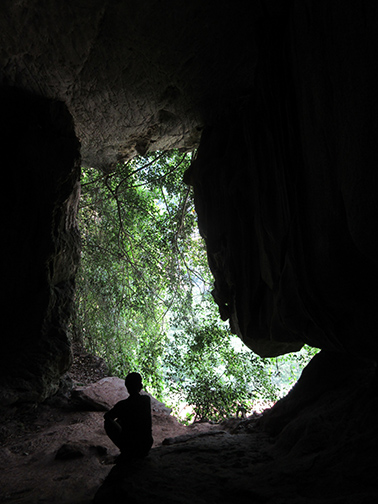
Cave in Laos photograph by Mark Ulyseas

( Live Encounters Poetry & Writing Volume Five November-December 2024https://liveencounters.net/2024-anniversary-editions/percy-aaron-all-for-nothing/ )

In a tiny village in northeastern Laos, poverty and misfortune make a tragic combination.

Mouk broke the hearts of all the young men in the village when she married Tham. Her beautiful face, twinkling black eyes and large dimples always made people feel special when she smiled at them.

Tham broke the hearts of all the young girls in the village when he married Mouk. He was goodlooking, muscular and hardworking. Unlike most of the other young men, he didn’t laze around playing cards, chewing tobacco or getting drunk. If he wasn’t in the field working alongside his father, he was helping his mother inside and outside their little hut. He was especially skilful at carving little figures from the pieces of wood that he saved from the kindling. Almost every child had a whistle, or a catapult made by him.

When little Pok was born all the village rejoiced. She was such a happy baby and like her mother, there was always a smile on her face. Everybody wanted to carry or play with her. By the age of four she was totally unafraid, hunting frogs and birds with her cousins.

One day, she wandered into the forest with the boys but lost them. A few hours passed before some of the children told Mouk. Dropping everything, she sent one of them to call Tham from the field and rushed off in the direction the children had last seen Pok. Soon Tham and a few villagers followed with sticks and knives. The forest while a source of food for the villagers, also had its dangers. There were plants that caused terrible allergies, poisonous snakes and occasionally wild animals. Some of the villagers even claimed that they had been chased by man-eating tigers. But the greatest danger of all were the bombies, little pellets designed to maim. American warplanes had sprinkled them indiscriminately during the war next door in Vietnam. These were uppermost in the panic-stricken minds of Pok’s parents.

Then they found her but their joy turned to horror. The little girl was standing at the edge of a large puddle laughing gleefully at the ripples she was causing each time she threw a stone into the water. The horrified villagers fled as a screaming Mouk grabbed Pok by the hair and slapped her several times.

By the time Pok and her parents had returned to their hut, word had spread about the child trespassing onto sacred land. Now nobody knew what revenge the enraged forest spirits would extract for their abode being defiled.

Over the next several days, Pok was locked inside their tiny room and various rituals were performed to propitiate the spirits. Tham and Mouk borrowed heavily to pay for the ceremonies.

Months later, little Pok fell sick. She started having seizures and losing consciousness. The whispers started as villagers remembered her throwing stones into the sacred pond. The village shaman prescribed various potions for the child and even more acts of atonement but nothing helped. Clearly the spirits were upset and she was being punished for desecrating sacred land.

When the shaman’s potions had no effect, the village chief told her parents to take her to the district hospital. The inexperienced and poorly trained doctor prescribed a course of antibiotics that left Pok very weak and even more disoriented. More visits to the hospital followed and Tham and Mouk went further into debt. There were evil spirits inside the girl’s head, the parents learned. Then a kindly nurse told them to take the girl to a hospital in Vientiane, the national capital. The treatment would be very expensive but there was no guarantee that their child would get better. They were devastated.

Back in the village, Tham, Mouk and his parents discussed what should be done. They pleaded with the villagers for help but the people were poor themselves. Besides, they were afraid to incur the wrath of the spirits.

Then the headman told them about factories in Thailand, where many people from other villages had gone to work, sending home more money every few months than they could ever earn from years of working their rice plots in Laos. Tilling the fields was more a man’s job and the factories preferred women whose work in garment-making was more delicate.

* * * *

Mouk and several women from her village had already spent a year at a garment factory in northeastern Thailand. The work was backbreaking but the long hours kept her mind off her family back home. Every time a colleague went home for a holiday, she sent back whatever she had saved. Then she waited eagerly for their return and news of her family. Tham and Pok missed her terribly, she was told. Also, Tham’s father had passed away and now he worked the fields alone. She considered visiting him and Pok but thought of all the money she would lose if she took a few weeks off. Next year, she would, she kept telling herself.

One day, Mouk overheard some of the women talking about places in Bangkok where girls earned more than 25,000 baht a month. That was incredible! With that kind of money, she could return home in a few months to start Pok’s medical treatment. An older woman told her that since she was beautiful, she could earn even more. Mouk didn’t understand that remark and gave it no thought. She and some of her friends discussed the matter and agreed to move to the Thai capital.

At the end of the month Mouk and two other young women arrived in Bangkok. The brother of the woman who had told them about the job met them at Mo Chit bus station. He would take them to a place where they could easily earn more than 25,000 baht a month, he assured them. Twenty-five thousand baht a month! Their faces filled with disbelief and greed. On the way Mouk’s mouth opened in amazement. Each building they drove past had more lights than her entire village. She couldn’t believe that there were so many cars and so many people in the world.

The taxi stopped at a building and they were taken into an office. A man and an elegantly dressed woman sat at a table that was bigger than Mouk’s house back in Laos. A younger man, with bulging biceps stood at the door. The woman, who was clearly the boss, told them to take off their clothes. Mouk was shocked. Only her husband had seen her naked. She stood staring at the woman unsure she had heard correctly. There were always misunderstandings in Thailand even though Lao and Thai were almost similar. After all she did have problems even understanding Lao, which was quite different from her native Khmu.

The other women shyly removed their blouses but Mouk stood still. The woman nodded to the man at the door, who stepped forward and slapped her hard across the head. Then grabbing her shoulders, he ripped open her T-shirt and pulled off her bra. He was powerful and before she could resist further, he had already yanked off her jeans and panties. The three women stood stark naked while the woman looked up and down at their bodies.

She barked something at the man who gave them back their clothes and led them to an upper floor where they were shown a room with a couple of mattresses on the floor and some wooden lockers.

Mouk was surprised when the next morning she did not have to rise early for work. Instead, later in the morning, another woman came to the room and told them that they would start work each day at 4.00 pm and finish at 3.00 am. They were given some beautiful clothes to wear and shown how to make up. kind of work they would have to do and were told they would have to sit and talk to men, pour their drinks, and try to get them to consume as much alcohol as possible. If the men wanted anything more, they could take them to the rooms upstairs, charge more and keep half the money.

The first night the thug who had hit Mouk in the boss’s office, raped her. He told her that he wanted half of all the money she made if she took customers to the rooms. Over the next six months, Mouk lost count of the number of men she had sex with. Some were gentle and generous, but others brutalised her.

A few times she wanted to take her life, but what would happen to Pok and Tham? True, she was making a lot more money than she had ever seen and another woman showed her how to hide her money inside her body. This way, she didn’t have to share everything with the young minders who took not only half their earnings, but also expected sex for free.

A doctor would visit them regularly for checkups, stressing the importance of making the customers wear condoms. Yet, he seemed to forget to wear one, when he got his free sex. Mouk stopped heeding his advice. If the customers didn’t want to use condoms, then she charged them double. It was simple.

Slowly the people in the club became like family. One of the minders, now her regular lover, brought her little gifts. On Sunday mornings the women women visited the local markets where Mouk bought clothes, cheap trinkets and fluffy toys for Pok. She even opened a bank account secretly and had already saved over 20,000 baht. She no longer sent money home when she found out that more than half was being pocketed by the carriers.

It was almost three years since she had left her village in northeastern Laos but every time she thought of returning, she decided to wait a few months longer and take back more money.

One Sunday morning, the girls wanted to go to Chatuchak, the massive weekend market but Mouk didn’t feel like joining them. She was feeling very tired. Her last customer had been with her till almost 4.00 am. Two days later she didn’t feel better and the doctor diagnosed the flu.

When she didn’t improve after a week, two of the girls accompanied to the hospital. She had to stay for a few days so that some tests could be done. One week later, there was no improvement and a friend from the nightclub came to the hospital with a suitcase containing her things. The Peacock Bar didn’t want her back. She had some terrible disease and would have to look for work elsewhere. Mouk was too tired anyway and put off the idea of looking for another job.

A fellow patient invited Mouk to share her hovel alongside the railway tracks. Too weak to work, she lay on a plastic sheet in one corner all day long. When she could struggle out of bed Mouk started working the streets, servicing street vendors and junkies, often in darkened doorways or inside the shack, if the others were at work.

As her conditioned deteriorated she didn’t have the energy to even get out of bed, soiling the rags she slept in. Soon she was too sick to even use the bedpan next to her. As the stench of shit got too much to bear, her hovel-mates threw her out. Back in the hospital, the staff didn’t seem to care.

A nurse suggested she go back to Laos; at least she would have family to take care of her. Back to Laos, she wondered? She hadn’t even thought of her husband and daughter in months. It had been more than a year since she had even received word from them.

A week later her lifeless body was heaped upon another in the police morgue.

In Mouk’s village in Laos, Tham wondered why there was no word from her. It was almost a year since he had heard from her and even longer since she had sent any money home. How he missed her! Even four years after she had left, he had still not got used to her absence. Fortunately, he had Pok, the spitting image of her mother, to keep him company. But some nights when the young girl cried for her mother, it was difficult, very difficult, not to shed tears too.

Each evening the other men in the village would meet for a drink and endless gossip. Tham could have joined them to ease the loneliness but he preferred to play with Pok and chat with his mother.

One day when the thought of another night without Mouk got too much, Tham decided to walk to the village where one of the girls who had left with Mouk lived. Maybe, they had some news. The village was about ten kilometres away and if he cut through the forest he could still be back by midnight.

The bombie that Tham stepped on, gave him no chance.. When he didn’t return by the next morning, his mother went to the village chief for help. By the time they found him, he had bled to death.

After the death of her son Tham’s mother tried to get in touch with Mouk. Word came back that she had left the garment factory more than two years earlier to work in Bangkok. They knew nothing of her current whereabouts.

After her father’s death Pok became even more introverted. The villagers shunned her as she was bad luck. Sometimes, they urged her grandmother to abandon her in the forest.

One day a team of researchers from the Institut de la Francophonie pour la médecine tropicale visited the village to gather data. Pok’s grandmother heard that some foreign doctors were among them. The old woman went to the camp they had set up and spoke to one of the volunteers accompanying the team. The young woman turned to the tall, white man and spoke to him in a language she didn’t understand. The foreigners talked to each other and asked to see the little girl.

The old woman took them to her hut and and watched as one of the doctors stuck a strange tube into his ears and then hold the other end against Pok’s stomach then chest. He pressed her stomach again and again and asked to see her tongue. The two white men and the young Lao woman continued speaking in their strange language. After a while, the young woman told Pok’s grandmother that they wanted her to bring Pok to Vientiane for some tests. She would not have to pay for anything, they assured her.

In Vientiane other doctors performed more tests on Pok. After a series of tests, a woman in a white coat, who spoke Khmu, mentioned words like epilepsy and phenobarbital, which meant nothing to the old woman. They gave her tiny white stones and told her that Pok must swallow one every day, for the rest of her life. And that soon Pok would be a healthy young girl.


© Percy Aaron

Percy Aaron is an ESL teacher at Vientiane College in the Lao PDR and a freelance editor for a number of international organisations. He has had published a number of short stories, edited three books and was editor of Champa Holidays, the Lao Airlines in-flight magazine and Oh! – a Southeast Asia-centric travel and culture publication. As lead writer for the Lao Business Forum, he was also on the World Bank’s panel of editors. Before unleashing his ignorance on his students, he was an entrepreneur, a director with Omega and Swatch in their India operations and an architectural draughtsman. He has answers to most of the world’s problems and is the epitome of the ‘Argumentative Indian’. He can be contacted at percy.aaron@gmail.com

On Writing

I was a compulsive reader by about the age of ten but hated anything to do with writing. That was work. In school, the topics for essays were guaranteed to freeze the fingers and atrophy the brains. One of our teachers had a system of grading that always tripped me up. Students who showed considerable improvement over the previous week got A’s, while those who didn’t, got D’s and had to do the assignment again.  Thus, weaker classmates could get higher grades than the better ones. True, this encouraged those who couldn’t write, but for others thought capable of producing good work, those weeks when our efforts were “deemed inadequate” could be discouraging.  I was writing essays for friends who did my math or Hindi homework. They’d get high marks for composition but I’d have to rewrite mine because of “insufficient improvement”. The number of ideas I had was limited and trying to ration them out amongst the 2-3 essays that I had to write the night before put a strain on my brain, my fingers, and on my grades.

In my early 20s I thought I’d like to be a writer. I started off with a couple of letters to the editor and though I had some short stories published I didn’t see myself as a writer. Writers were people who wrote books, I thought. And that was hard work.

Then with my 25th birthday approaching I was expecting a massive depression.

On that day, a year before, my heart had been broken and I still hadn’t got over it. I decided that I’d be able, from the depths of my despair, to write something really profound. I was on holiday, far away from the city that we both lived in.  It was my birthday and I decided to treat myself to lunch in the beautiful, and expensive, Lake Palace Hotel in Udaipur. I was a bit overwhelmed by my surroundings. But there was nobody to share the meal with, or the shock of the bill when it arrived.

My birthday came and went. Weeks later I remembered that I had forgotten to be depressed. I had missed the chance to wallow in despair and profundity. So I faked a depression and wrote a short story. I thought it was really good and sent it off. But it got me my first rejection slip. The editor had got it wrong, I thought. This was real literature. Submission after submission was followed by rejection after rejection. Seeing all those rejects gave me a depression.  And this one wasn’t faked.

Based on the story, one magazine did offer me a job as a staff writer. That was some consolation for the rejection slip they included in the envelope. But if they had a problem with my story, I had a problem with their politics and I declined politely.

Since then there has been little inclination to write. Once in a while I feel differently but prudence and procrastination suppress any literary urges.

@ Percy Aaron, 29 July 2013